At last, a new post

I have not posted here since May.

As April closed, I was focused on all that Covid-19 was stealing from us—visits with family, travel, especially the loss of a trip to London for a Within Temptation concert. I was frustrated with the new complexity of ordinary things like grocery shopping. Nothing was simple any more.

Normally a restless person, always busy, working, running errands, avoiding sitting still, the “new normal” meant I could no longer just get up and go out if I wanted or needed to.

I began working from home in March, and we settled into a routine. That really describes it—routine. Every day became the same—only the words coming out of the talking heads on TV changed from day to day, and after awhile, even they weren’t changing much.

My natural bent is to intellectualize things, and, looking back through my notebooks, I see I was doing just that—trolling the internet to find information so that it would all make sense. I searched out fatality statistics for the flu, for instance, and discovered that the CDC has only provided estimates of flu prevalence and deaths. I needed to contextualize what I was seeing on TV about hospitals over-flowing with patients in NYC; when I drove past our nearby hospital, the traffic around it seemed the same, no long lines of people waiting to get in and even a few empty parking spaces—how could it all be true?

I knew no one who’d become sick. I knew no one who’d been quarantined as possibly sick. Looking at the numbers, with a population of 330 million, and cases only numbering in the tens of thousands, it was clear that most people didn’t know anyone who’d been sick. This increased the unreality of it all.

Then on May 9, I got one of those phone calls.  Someone close to me and about my age was hospitalized with Covid-19. In that moment, I felt I had been pitched into the ocean amidst the Perfect Storm. This person was sick and frightened and I could do nothing to help. Phone calls felt so inadequate as the quavering voice on the other end said, “I’m going to die…” 

The next day, I wrote in my notebook, “Suddenly everything I’ve been doing seems frivolous and silly…before, I was in a bubble. We have been doing what we’re supposed to do—stay home, wear a mask at the grocery, and we have stayed well. And it has induced this illusory sense of well-being, that I am protected. But I am not.”

Suddenly, Covid-19 was real. Not only did I now know someone who was seriously ill with it, but I also received the reality—that it could have been me in the hospital.

Since that day, writing has felt impossible.

I tried working on a few posts in my notebooks, but nothing worked. Nothing clicked. Nothing mattered. I’d read a draft the next day only to pronounce it “not compelling—who would care?” Every time I tried to write, I came up empty.

Despite lockdowns and quarantines, events on the national scene continued to tumble. Increasing case numbers, increasing fatalities, George Floyd, protests, violence, endless political ranting, more violence, more cases, states opening, more lockdowns and protests and violence.

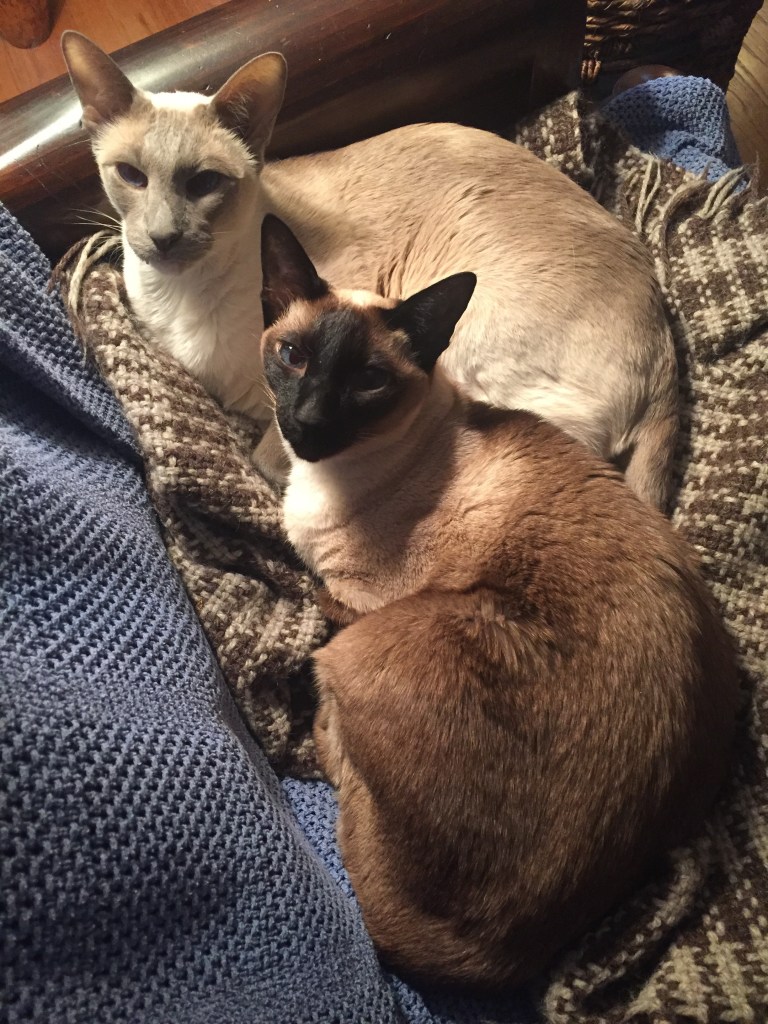
Through it all, writing anything began to feel like a pointless exercise. My efforts to write led me down innumerable rabbit holes, petering out into unfocused drivel. I kept up my daily pages, but they devolved into insignificant chronology and description—what I had for dinner, what my cat was doing, and a lot of “I don’t know what to write” over and over. Then, sometime in the summer, I stopped writing altogether.

The other night, plagued by returning insomnia and trying to avoid that problematic blue light, I opened Natalie Goldberg’s book, Wild Mind. This is where I landed:

“The only failure in writing is when you stop doing it. Then you fail yourself. You affirm your resistance. Don’t do that. Let the outside world scream at you. Create an inner world of determination…”

And here I am today, creating this post. Does this mean I’ve emerged from my paralyzing bout of writer’s block? I doubt it heals so quickly. But maybe I’ve finally found a way into that inner world of determination.

Postscript. 

Yet another tumultuous event happened yesterday, one that strikes close to my heart—the passing of Ruth Bader Ginsburg. On a trip to the Supreme Court with my law school class in 2007, we walked past her office, her door standing wide open. A couple of us lingered there. I craned my neck to see inside, to glimpse her if at all possible. But all I could see was a desk and empty chair. Even so, I felt close to greatness in that moment.
Covid-19 Notepad – Day 49 What we risk losing

The media has been much concerned of late with the idea of re-opening the economy, as states begin to dial back their stay-at-home orders and lockdowns. We were told these would “flatten the curve” and protect the healthcare system from a fatal crash. We have hunkered down to slow the spread of the virus. The deaths—of friends, acquaintances, loved ones, the bodies bagged and stacked in makeshift morgues—have terrified us, motivated us to stay in, stay home. 

Now (though we are surely not out of the woods yet), we begin to contemplate a new normal, where restaurants are half full, crowded bars are a distant memory, flight attendants wear masks, and we take a number to enter grocery stores. BBC News just ran a story about travel in this new world, complete with an airport disinfectant scenario straight out of Doctor Who

As we hunkered down, bans on large gatherings were among the first social distancing strategies put in place. Now it’s been suggested that such gatherings may not be allowed this year. Suppose, for the sake of argument, the bans on gatherings of 10, or 100, people remain in place for a year, two years, or longer. As we shrink our worlds to avoid the risk of infection, what becomes of concerts, performances, readings and so many other events, and the artists and artist communities that these support?

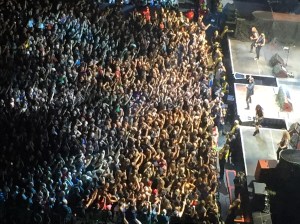
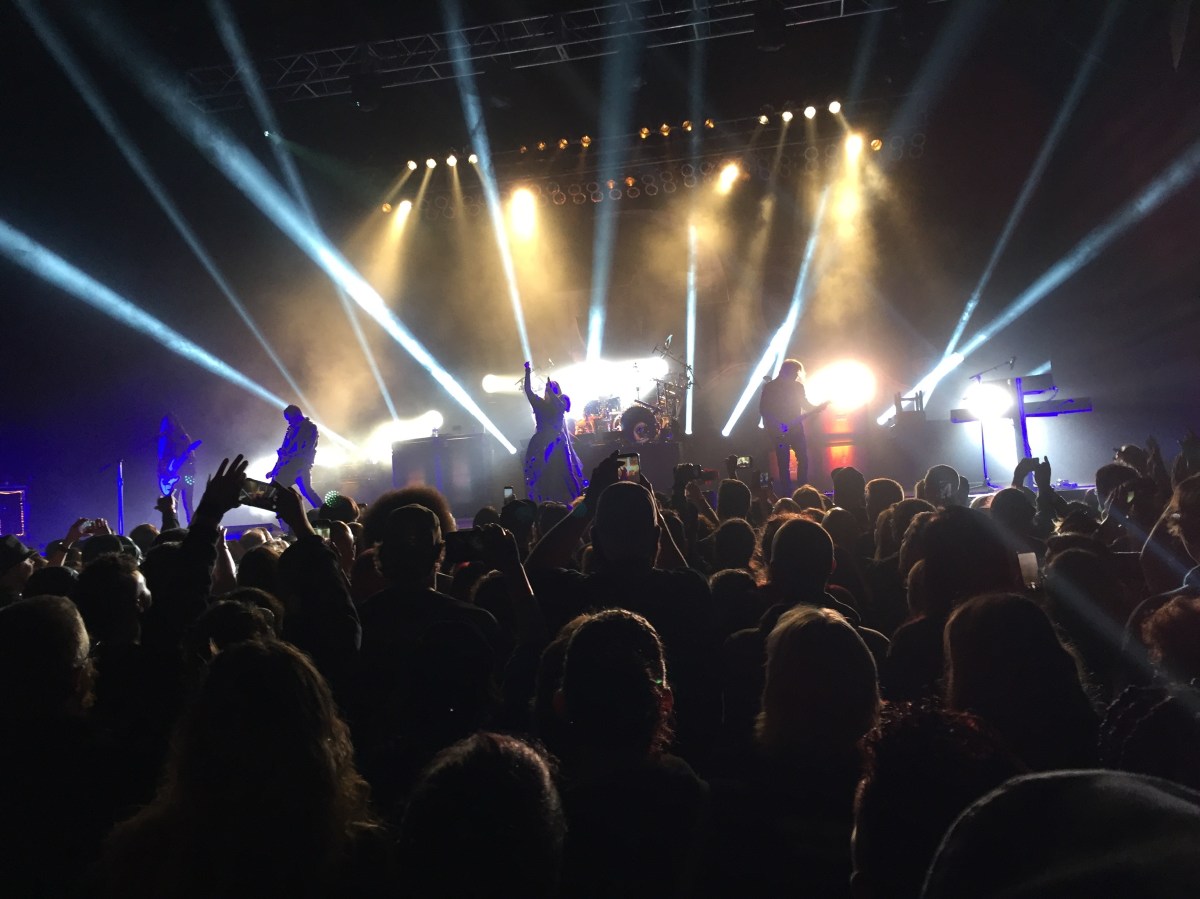
There was a time when this would have mattered less to me. I wasn’t going out to events much. But that trek to Groningen, Netherlands, to my first live rock concert ever, drastically changed my perspective. We were welcomed into a community—the metal community—where we stood shoulder to shoulder, hands raised, utterly carefree and full of life, singing the songs together as though we were singing hymns in church. What becomes of this community if we can no longer gather?

Large gatherings like this, whether 20 people for a poetry reading or 20,000 for a heavy metal concert, are intrinsic to every arts community.

If we have learned nothing else from our national experiment with Zoom meetings, it is that in-person is just better, whether it’s a meeting with colleagues, a trip to the ballgame or a concert.  Relegated to the camera’s view, we lose a powerful world of nuance and non-verbal cues, of closeness and camaraderie. But perhaps especially for art, it is that personal, real-time experience shared with others of like mind that cements our relationships and unites us into community.

While community brings people together, it also serves a another purpose. Communities sustain the artists around which they form, and the music community is no different. Indeed, artists and their art-making have generated vibrant communities around the world, helping to reinvigorate cities everywhere and making arts a vital economic engine that can help ensure the continuation of independent artists making art for the joy of making art. 

If we lose large gatherings, we risk losing the arts. The sustenance these large gatherings provide to artists—emotional, professional, financial—can vanish if performance venues can’t survive the new normal.

Without a question, even in a strong economy, arts are a tough way to make a living. A lot of parents, despite buying all those music and dance lessons, have pushed kids away from careers in the arts, telling their budding photographers and dancers, “You won’t be able to support yourself.”

This economic reality is a fact of the music world, where touring is a way of life for bands, who depend on tours to generate income. For heavy metal, historically, this has been especially true, since metal has tended not to get the radio play enjoyed by other musical genres  (a topic of its own, outside the scope of this post). Few bands have the stamina and sustained creativity, to reach that elite world of musical nirvana where significant money is to be made. Before the pandemic had even started to unhinge our world view, Kobra Paige, of Kobra and the Lotus, talked about the economic realities she and her band face.

For our part as fans, we stand to lose a kind of sustenance too. We will lose the exhilarating experience of live concerts. I went so long without them, but now, reawakened, I crave them. I think about the concerts I’ve been to in the last year, that excitement, that feeling of being a part of this big, crazy family. We fed on the bands’ energy, just as the bands fed off ours to keep them going, night after night.

Vaccines and antibody tests already in development, contact-tracing tools like apps, and other public health strategies, if they work, might permit a return to large gatherings. Vaccines are undergoing trials in several countries. Apps are in development that will allow discovery of every person who stood within 2 feet of you; China has a version, UK is about to unveil one. In the US, approaches like these will encounter significant roadblocks due, for example, to our willingness to tolerate distrust in science, or to our laser focus on individual rights to privacy at the expense of the public good. From another perspective, the fear is that these strategies would “coerce” people into trying to catch the disease.

If we want to return to even a semblance of normalcy, we need to weigh our responses to public health tools and strategies with our common good in mind. We need to think about the impact of our personal decisions on others and on the communities we care about. We can no longer think solely of ourselves and our individual happiness. We must understand, now more than ever, that our happiness and well-being are tied directly to the happiness and well-being of others.

What do you think? Do large gatherings matter?

Covid-19 Notepad: Musings on Day 26

Today is day 26 of our self-isolation.

In Massachusetts, the number of coronavirus cases as of this afternoon at 4 pm is 26,867, up from 20,974 on Friday—an increase of almost 6,000 cases just over the weekend. In the same time period, total deaths went from 599 on Friday, to 844 today.  Governor Baker tells us that the peak is coming in the next ten days, but probably around April 20th. The numbers will get worse.

Following these developments over the weekend made me seek context. In some quarters, the fuss continues that this is just another kind of flu, and for awhile, I was harboring similar thoughts. So I went looking for some facts. It turns out that the CDC does not track actual flu cases. When you look into this, you find only estimates—no hard data. (I’m not a researcher, so the numbers may be out there; please share if you find them). 

But stats for deaths generally are available.  On any given day in New York City—normally—about 145 people, plus or minus a few, will die of various causes—heart attack, cancer, accident, violence. On the day I was looking at this, I found that 518 New York City people had died of Covid-19 alone! And a friend quickly pointed out after I posted this on Facebook that the one-day Covid-19 death toll had soon after hit 779.

This is not the flu. These are not usual flu season numbers.

It has now been almost 2 weeks since we went to the grocery store, and as perishables and essentials dwindle, we’ve begun to think about our next excursion. We also think we’ll cover our faces. 

To that end, I dug out my collection of bandannas. (I’ve been holding onto these things for fifty years, waiting for them to come in handy.) I indulged in a little nostalgia as I laid them out and folded them, inhaling their dusty homeliness.  My mom and I collected them for family camping trips; she used to pull one around her head for the morning trek to the ladies’ room, lest anyone see her unkempt hair. (I also remembered her wearing them while she was in chemotherapy, but that wasn’t a thought I wanted to dwell on just then.)

Will I wear one of my old, mint-condition bandannas to the grocery store this week? Next month? Or will we all turn to grocery delivery services? And give up the pleasure of perusing the potatoes and zucchini in real time? Will we forego that special kind of family quality time—the shopping trip? Or will we have to provide certification of virus-freedom at the entrance to the mall?

Or, for me, worse yet—I’ve only just begun going to rock concerts, reveling in standing shoulder-to-shoulder with 500 strangers while screaming my lungs out. (My May line-up of Asking Alexandria, Five Finger Death Punch & I Prevail are all postponed until September, along with the Within Temptation & Evanescence show we were supposed to attend at London’s O2 last week.) Will we have to present shot records to get in?

CNN showed the Chinese approach to the new Covid-19 normal this weekend—an app that tracks a person’s movements and gives you a QR code indicating whether you’ve stood next to anyone with Covid-19. You show the code to be admitted to an event. So just like we hold out our phones displaying our tickets to concerts, you would show your code to be admitted. Would anyone dare get in line with anything other than a green-for-go code? A recent Supreme Court case came to mind, the 2018 Carpenter cell phone case, where the Court decided that the use of cell-site location information records was a Fourth Amendment search, requiring a warrant and probable cause. Making an app like the Chinese Covid-19 tracking app unlikely here, at least for now.

What do you think the future holds?

Covid-19 Notepad: The Grocery Trip

Today, we made our first foray to the grocery store after two weeks of self-isolation. In the last two weeks, we have gone out together once for a walk in the woods near our house, and once I drove to the beach a few miles away to go running. Otherwise, the only people we’ve seen have been the talking heads on TV.  

After perhaps too much TV, I awoke this morning on edge about the excursion. It was exciting to think about just getting out of the house (such a change—I used to long a for a day to just stay home), but today, I also worried about what the store would be like, and what might happen to us because we went. 

Our store is a typical, American grocery-extravaganza, always clogged with shoppers—families, twenty-something college kids from the nearby university, couples, moms with babies and kids in tow, elders on scooters. We planned our trip for mid-day on a Wednesday, since normally, on a Wednesday afternoon the store is  deserted. 

Today, when we arrived at the shopping plaza, the parking lot was empty, except for a mob of cars huddled at the grocery store’s end of the lot. It was definitely busier than a normal Wednesday.

Inside, where you grab a cart, a girl in an apron and gloves was wiping down the carts, and she passed one to us. The little dining area where you can usually sit down for a snack from the grab-and-go was blocked, the chairs upside down on the tables. Just beyond the registers, the path to the produce—or the bakery, depending how you look at it—was as congested as ever, with people hovering around the rotisserie chickens and turkey legs, and at the counter, eyeing the cakes and donuts. 

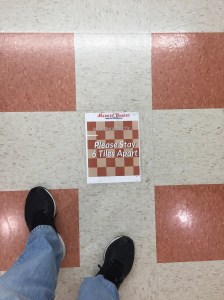
Signs on the floor remind us to keep
our distance.

In the produce department, the crowd did not thin out as I’d expected. The aisles were busy. Some people wore masks, several wore scarves over their faces. Most were alert to the distance between us, and we nervously smiled as we tried to pass each other to get to the avocados. Signs plastered to the floor and across the meat aisle and deli counters helped us remember to keep the six-foot distance in mind.

We had a long list of items we’d been tracking over the last two weeks, for routine meals, particular recipes, or staples we always keep on hand. We were moving quickly through the store, giving wide berth to other shoppers. I am not usually phobic, and generally I enjoy grocery shopping, looking around, investigating new or interesting items. But today, midway through, a sense of foreboding began to rise in me. Just being here so long felt somehow dangerous. I need to get out of here! Our cart was full. It would cost a fortune. It’s time to go. Now.

Finally, we moved to the checkout counter. Here, unlike most days, we did not have to wait. We moved right into a checkout lane, behind a woman with just a few items in her cart. The masked man behind us hung back, easily ten feet away. No rushing to grab a divider to separate orders (in fact, there were no dividers at all). We’ve gotten used to using our own reusable bags—I have a picturesque one from our trip to Germany last summer—but today, no, the bagger said, can’t use those now.

Back at the car, we reorganized the bags into our reusable bags and filled the back of my Forester. In the car, we slathered on the hand sanitizer and drove home.

We need to order a few things online. For some reason, yeast and flour are hot commodities—has everyone begun baking their own bread? And we’ll do without a few things for awhile. And the bill was a shocker, but the pantry is fuller than it’s ever been. And we’re confident we can remain hunkered down for several weeks before we need to do this again.

Covid-19 Notepad

Or how I learned to stop worrying and love the virus…

How are you doing? We are doing OK.

Day 8 of self-isolation.

The days have settled into an easy rhythm–of coffee, meditation, work, and workouts, with healthy doses of cat-cuddling and cooking and eating. The stash in the fridge is starting to diminish as we use the produce we stuffed in there a week ago on our last grocery run. Not missing the half-hour commute to the office–time that has been transformed into writing time–writing for me, rather than for work.

The confusion and anger I felt initially has also given way. The gentle stretch of the day, with my time more under my own control seems to have reduced my anxiety. Since we are on a fixed income now, we don’t have the paycheck worries that so many others have.

I’ve reduced the amount of time I spend reading and watching news. We’ve got the tips on how best to avoid Covid-19; we’re hunkered down, staying in and away from others. I do check for the latest stats–our county now has 90 confirmed cases and Massachusetts has 2,417, as of this afternoon. However, I could not avoid reading the story reported by the Washington Post, that some hospitals are considering universal DNR (do not resuscitate) orders for coronavirus patients, a painful and alarming development for all, but especially for those in our age group. Media just increases my anxieties.

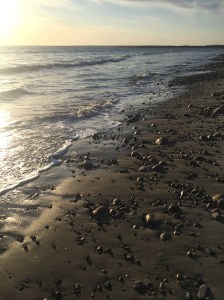
But that’s where exercise comes in. This afternoon, I got out for a run at the beach, where the air was dazzling and the waves sparkled over the sand and cobbles.

Stay well, stay tuned.

Covid-19 Notepad

Driving home from my office the other night, I was thinking about the coronavirus situation we’d all been talking about–events cancelled right and left, meetings moved to cyberspace, kids pulled out of activities, schools closing. Panic. Everywhere. Then I heard these words:

“when the fear and panic takes a hold

look within your soul

when your sorrow drags you down below

you must take control

your strength will unfold

take control”

“Take Control”, Killswitch Engage, Atonement, 2019

The coronavirus situation makes us feel confused, anxious, angry, panicked. But this song got me thinking–panic and control are opposites.

When we feel panicked, we feel out of control. We feel we suddenly have no control over our environment. Our feeling of power–the ability to control our environment and bring about change–evaporates. When things get out of control, we panic amid the chaos.

The chaos feels very real right now. Our war with the coronavirus is guerrilla warfare. We can’t see it, and without testing, we can’t track it in our corner of the world. It feels inexorable, unavoidable.And we feel helpless, that we can’t do anything about it. I don’t know about you, but I’ve been feeling pretty panicked and out of control.

But the song reminded me that I can act to take back control. Right now, simple acts like washing hands, carefully wiping surfaces are rebel acts–acts of defiance, insurgency. toward this invisible enemy. Doing these things allows us to take back control, take it into our own hands. We stand apart from others as an act of self-protection. As we take control in these simple ways, we protect ourselves, families, communities.

These small acts of control and defiance rebuild our sense of personal power in this guerrilla war against Covid-19.

I’ve begun–I’m working from home now; we’re planning our strategic trip to the grocery store, and we will be ok.

Stay tuned. More to come.