
Covid-19 Notepad: Musings on Day 26

Today is day 26 of our self-isolation.

In Massachusetts, the number of coronavirus cases as of this afternoon at 4 pm is 26,867, up from 20,974 on Friday—an increase of almost 6,000 cases just over the weekend. In the same time period, total deaths went from 599 on Friday, to 844 today.  Governor Baker tells us that the peak is coming in the next ten days, but probably around April 20th. The numbers will get worse.

Following these developments over the weekend made me seek context. In some quarters, the fuss continues that this is just another kind of flu, and for awhile, I was harboring similar thoughts. So I went looking for some facts. It turns out that the CDC does not track actual flu cases. When you look into this, you find only estimates—no hard data. (I’m not a researcher, so the numbers may be out there; please share if you find them). 

But stats for deaths generally are available.  On any given day in New York City—normally—about 145 people, plus or minus a few, will die of various causes—heart attack, cancer, accident, violence. On the day I was looking at this, I found that 518 New York City people had died of Covid-19 alone! And a friend quickly pointed out after I posted this on Facebook that the one-day Covid-19 death toll had soon after hit 779.

This is not the flu. These are not usual flu season numbers.

It has now been almost 2 weeks since we went to the grocery store, and as perishables and essentials dwindle, we’ve begun to think about our next excursion. We also think we’ll cover our faces. 

To that end, I dug out my collection of bandannas. (I’ve been holding onto these things for fifty years, waiting for them to come in handy.) I indulged in a little nostalgia as I laid them out and folded them, inhaling their dusty homeliness.  My mom and I collected them for family camping trips; she used to pull one around her head for the morning trek to the ladies’ room, lest anyone see her unkempt hair. (I also remembered her wearing them while she was in chemotherapy, but that wasn’t a thought I wanted to dwell on just then.)

Will I wear one of my old, mint-condition bandannas to the grocery store this week? Next month? Or will we all turn to grocery delivery services? And give up the pleasure of perusing the potatoes and zucchini in real time? Will we forego that special kind of family quality time—the shopping trip? Or will we have to provide certification of virus-freedom at the entrance to the mall?

Or, for me, worse yet—I’ve only just begun going to rock concerts, reveling in standing shoulder-to-shoulder with 500 strangers while screaming my lungs out. (My May line-up of Asking Alexandria, Five Finger Death Punch & I Prevail are all postponed until September, along with the Within Temptation & Evanescence show we were supposed to attend at London’s O2 last week.) Will we have to present shot records to get in?

CNN showed the Chinese approach to the new Covid-19 normal this weekend—an app that tracks a person’s movements and gives you a QR code indicating whether you’ve stood next to anyone with Covid-19. You show the code to be admitted to an event. So just like we hold out our phones displaying our tickets to concerts, you would show your code to be admitted. Would anyone dare get in line with anything other than a green-for-go code? A recent Supreme Court case came to mind, the 2018 Carpenter cell phone case, where the Court decided that the use of cell-site location information records was a Fourth Amendment search, requiring a warrant and probable cause. Making an app like the Chinese Covid-19 tracking app unlikely here, at least for now.

What do you think the future holds?
Covid-19 Notepad: The Grocery Trip

Today, we made our first foray to the grocery store after two weeks of self-isolation. In the last two weeks, we have gone out together once for a walk in the woods near our house, and once I drove to the beach a few miles away to go running. Otherwise, the only people we’ve seen have been the talking heads on TV.  

After perhaps too much TV, I awoke this morning on edge about the excursion. It was exciting to think about just getting out of the house (such a change—I used to long a for a day to just stay home), but today, I also worried about what the store would be like, and what might happen to us because we went. 

Our store is a typical, American grocery-extravaganza, always clogged with shoppers—families, twenty-something college kids from the nearby university, couples, moms with babies and kids in tow, elders on scooters. We planned our trip for mid-day on a Wednesday, since normally, on a Wednesday afternoon the store is  deserted. 

Today, when we arrived at the shopping plaza, the parking lot was empty, except for a mob of cars huddled at the grocery store’s end of the lot. It was definitely busier than a normal Wednesday.

Inside, where you grab a cart, a girl in an apron and gloves was wiping down the carts, and she passed one to us. The little dining area where you can usually sit down for a snack from the grab-and-go was blocked, the chairs upside down on the tables. Just beyond the registers, the path to the produce—or the bakery, depending how you look at it—was as congested as ever, with people hovering around the rotisserie chickens and turkey legs, and at the counter, eyeing the cakes and donuts. 

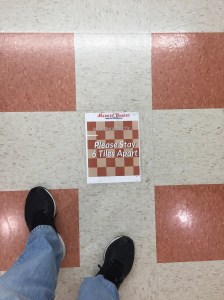
Signs on the floor remind us to keep
our distance.

In the produce department, the crowd did not thin out as I’d expected. The aisles were busy. Some people wore masks, several wore scarves over their faces. Most were alert to the distance between us, and we nervously smiled as we tried to pass each other to get to the avocados. Signs plastered to the floor and across the meat aisle and deli counters helped us remember to keep the six-foot distance in mind.

We had a long list of items we’d been tracking over the last two weeks, for routine meals, particular recipes, or staples we always keep on hand. We were moving quickly through the store, giving wide berth to other shoppers. I am not usually phobic, and generally I enjoy grocery shopping, looking around, investigating new or interesting items. But today, midway through, a sense of foreboding began to rise in me. Just being here so long felt somehow dangerous. I need to get out of here! Our cart was full. It would cost a fortune. It’s time to go. Now.

Finally, we moved to the checkout counter. Here, unlike most days, we did not have to wait. We moved right into a checkout lane, behind a woman with just a few items in her cart. The masked man behind us hung back, easily ten feet away. No rushing to grab a divider to separate orders (in fact, there were no dividers at all). We’ve gotten used to using our own reusable bags—I have a picturesque one from our trip to Germany last summer—but today, no, the bagger said, can’t use those now.

Back at the car, we reorganized the bags into our reusable bags and filled the back of my Forester. In the car, we slathered on the hand sanitizer and drove home.

We need to order a few things online. For some reason, yeast and flour are hot commodities—has everyone begun baking their own bread? And we’ll do without a few things for awhile. And the bill was a shocker, but the pantry is fuller than it’s ever been. And we’re confident we can remain hunkered down for several weeks before we need to do this again.

Covid19 Notepad

Or how I learned to stop worrying and love the virus…

A few weeks ago, when I first began to pay attention to the coronavirus, now known as Covid19, I watched the expanding crisis in China, its slow beginning, first a single news story about this strange new virus that appeared probably in a market somewhere in Wuhan, I didn’t think much about it. Yet I continued to follow the stories–next a few more cases, then quarantines, and hospitals being built overnight. Wait–hospitals built in just days–what makes a country do that?

Then one day, it occurred to me, this is not going away soon. And more recently I’ve begun to feel that this virus will be the new “common cold”. This is the future, the new normal. And it brought to mind other memories from my childhood–duck and cover drills, bomb shelters, my mother hushing us because “The President is going to tell us if we’re going to war.

I wrote the above paragraph only to discover a few minutes later that the present President would also address the nation about a crisis, as Kennedy had–a new crisis–a new kind of crisis. A crisis that will test us as a country, but more importantly, it will test each of us in ways the Bay of Pigs never did.

Massachusetts today declared a state of emergency. More cases will appear tomorrow. The prestigious New Bedford Half Marathon has been cancelled. What’s next?