Books: Not Just Another Rock Bio

Noise Damage: My Life as a Rock ‘n’ Roll Underdog by James Kennedy, Lightning Books Ltd., 2020

Noise Damage is a great read. It’s written in a breezy, honest style that makes you feel like you’re sitting in a pub with Kennedy as he regales you with his story. But it also feels like you’re peering into a hidden world. If you’ve ever been crushed in the pit at a rock concert and wondered what it’s like to be up there, to get on the bus every day and do it again and again, if you’ve wondered how they got there and why —Noise Damage will tell you.

Noise Damage is the story of a guy from backwater Wales who just wants to be a rock star. But the book is also a memoir, a soul-searching telling of what it means to claim your real calling. In Kennedy’s case, that calling is making music.

Born in 1980, Kennedy grew up in a working-class family in south Wales. Leaving Cardiff not long after Kennedy was born, the family moved first to a gritty, urban area, and then to a village “in the middle of bloody nowhere.” On his ninth birthday, Kennedy’s dad gave him a little Spanish guitar (that he later learned his father had “nicked from somewhere’) and showed him a few things on it. “I played that damn riff over and over (and over),” Kennedy writes, “maybe a thousand times, and the fact that I could actually do something with this thing made me feel like I’d just discovered a buried superpower.” After a few “lessons” from a one-legged, Hendrix-worshipping local guy called Sid, Kennedy knew he could only be a guitarist.

But the path to rock glory would not be easy. The road took a serious turn a year later when doctors found tumors in both Kennedy’s ears. Surgeries left him with only sixty percent of his hearing and ferocious tinnitus.

Kennedy was a “frustrating paradox”, struggling through school despite being a voracious reader well-versed in literature, history, and politics; he celebrated the end of high school by setting fire to his uniform and books. But high school was a means to an end: getting into college to study music.

Through sheer will power, Kennedy made it to college, where he encountered music theory for the first time—and snagged an opportunity to work in a real music studio.

Once Kennedy found his way around the studio, he seized a further opportunity—to make an album, “the album, that threw all of the things I loved into one giant, ambitious, uncommercial, multi-genre melting pot of seething, unpredictable musical indulgence [with] an angry dose of politics and … filthy noise and pounding drums.” This was Made in China, his first CD (later remade as Kyshera’s 2nd album in 2012).

With his no-holds-barred approach and absolute belief that he could do whatever he set his mind to, coupled with the digital technology that was changing the music industry, Kennedy made the entire album himself, writing and singing every song (despite having never written or sung a song), playing every instrument—digitally or otherwise—recording, engineering. It took two years of putting in every spare moment, often working through the night, until it was done. Then Kennedy even handled his own promotion, mailing CDs to all the music magazines.

This is where Kennedy’s story really takes off. Awash with rave reviews, every interviewer and industry big-wig wanted to know: “When are you next performing in London?” Kennedy had to get a band together. After plastering most of Wales with recruitment flyers (no social media, no internet back in the day), his band, Kyshera, began to take shape.

Kyshera’s run was a roller coaster ride. From crazed, screaming drummers and the exhilaration of the band’s first gig to the hard reality of the music industry’s crash and burn; from their first festival—before a crowd of bikers, where frontman Kennedy managed to fall and slash his face open in the middle of the set, spraying blood everywhere—to endless weekends playing covers to make money just to put gas in the bus to get to the next gig. A trip to Toronto for a major festival proved to be the gig from hell with a full-throttle adrenaline rush, sufficient to lure them back a second time—all against a backdrop of trying to hold on to the day job and have a personal life.

Peppered with British-isms, you might wish you had a Duolingo app for British slang. And if the “bad” words were left out, Noise Damage would be a much shorter read—I warned you it’s honest writing! And don’t read this book to get an understanding of the music industry or how to break into it; Noise Damage is not that.

Noise Damage is about coming of age, about truly embracing one’s calling no matter what it costs. And these days, when kids are forced to decide their direction early on, Noise Damage stands as a truthful telling of what it means to pursue your dream in a real world that can be brutal, unkind, and downright mean. Noise Damage is also an expression of irrepressible spirit, persistence despite significant odds against success, and the saving grace that is music.

Next time you get to a concert early to claim your spot at the rail, and you’re confronted with a band—the opener—that’s not the one you came to see, give them a listen anyway. As Kennedy says at the end of Noise Damage: “P.S. Please support artists. It’s harder than it looks.”

I first came across James Kennedy’s music through a tweet from July 2020, promoting the first single from his most recent album, Make Anger Great Again, “The Power”.

For something completely different, try Kennedy’s latest release, “Insomnia”.

You can also find on Spotify the audio book of Noise Damage, read by James Kennedy.

James Kennedy is also on SoundCloud & Bandcamp.
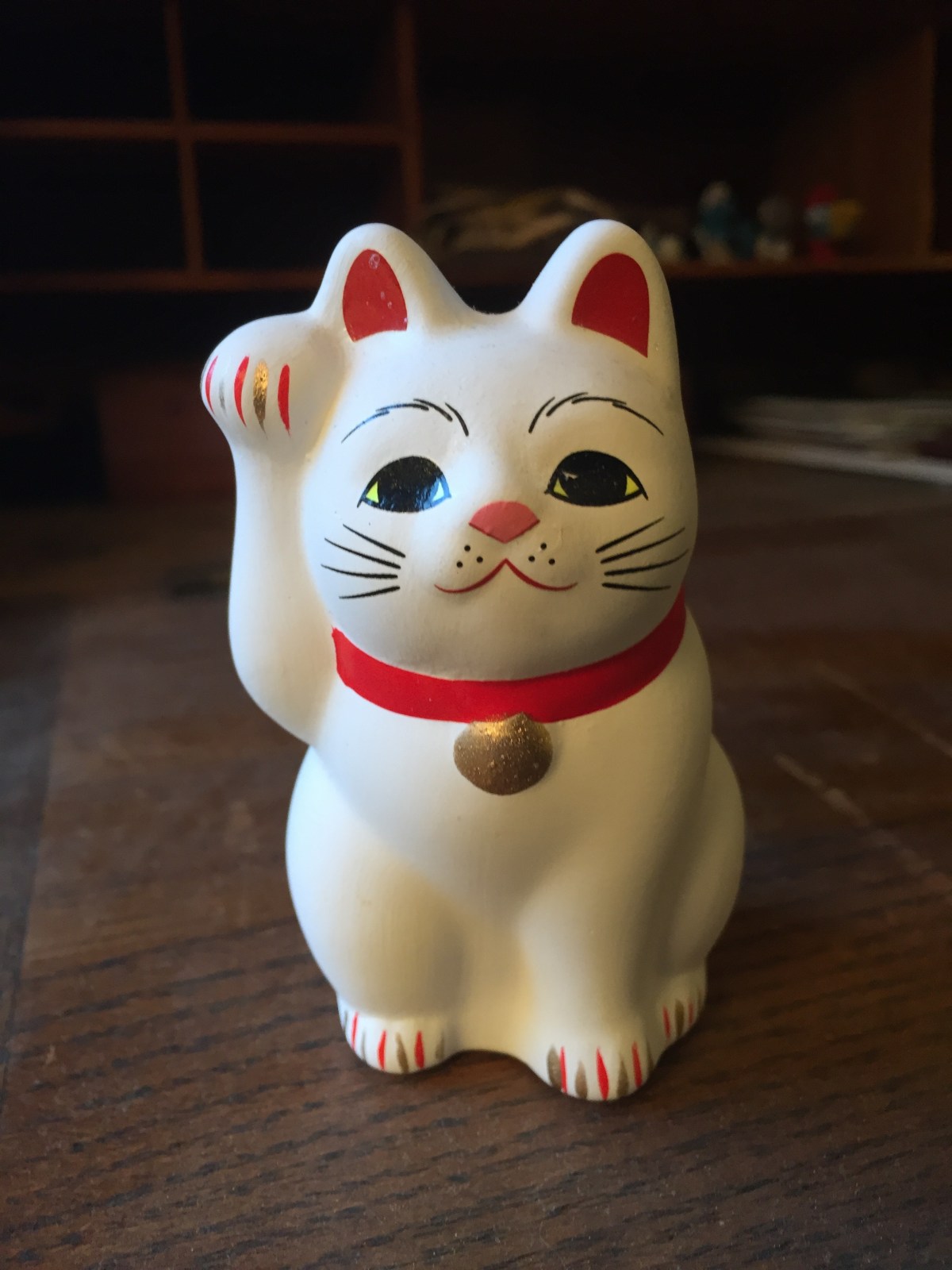
Finding the Home of the Good Luck Cat

With almost a year of Pandemic behind us and unable to travel, I dust off memories of our last big trip, to Japan, in August 2019…

We were in Tokyo, and one day, my original plan was to go to Asakusa for the day while my husband was in meetings. I’d been there with him on a previous trip, and I knew I could easily spend hours and hours there among the temples. But dinner plans settled the night before meant that today, I needed to find a simpler option.

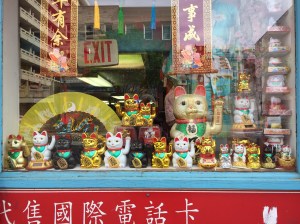
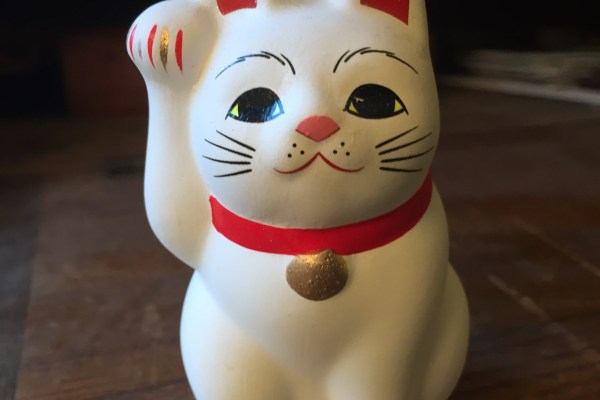
Good Luck Cats fill a window near Chinatown, Washington D.C. April 2019

I googled “don’t miss sights Tokyo” and when the list appeared, I skimmed it for a place I’d never been. One caught my eye—Gotokuji—the home of the lucky cat. Some of the reviews said, “Don’t bother—boring and hard to get to”, but others said, “If you love cats, you should go.” I decided to go.

I worked out the route with the help of Google maps: from Shinagawa Station on the Yamamoto line to Shinjuku and there change to Odakyu line to Gotokuji Station, then 15 minute walk to the temple. It sounded like a perfect opportunity to try my place-finding skills in the Tokyo suburbs.

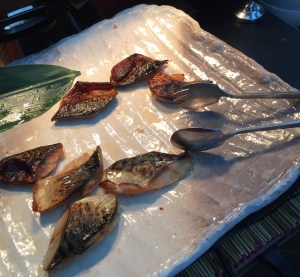
mackerel

After a breakfast of ramen noodles, miso, and a taste of mackerel, among other things, I set out from our hotel. The morning was very hot and humid, and within minutes, I was dripping sweat as I walked to Shinagawa station. 

I caught our accustomed Yamamoto line train to Shinjuku. We’d done this several times already—to go to Shibuya to do the Scramble, to the Kinokuniya bookstore in Shinjuku, and our very first outing, to Shinjuku Gyo-en National Garden. We’d had some challenges finding the garden once we got out of the station that first day, but at this point about a week into our stay, I felt confident. 

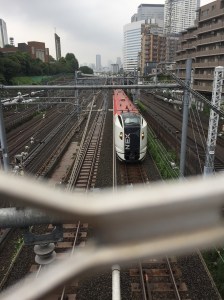
Trains running past our hotel in Shinagawa

Everything was going smoothly until I went looking for the Odakyu line. I found myself in another part of the station able to go no further since I’d put my ticket in the entrance machine and it believed my journey was done. Does this mean I have to go out of the station?  I was in complete confusion until I spotted ticket vending for the Odakyu line, where I was able to buy a ticket for Gotokuji, and realized, yes, I had to go out of the station to re-enter for the Odakyu line. 

Going away from Tokyo at late morning, the train was nearly empty.  Arriving at Gotokuji station—just a platform—I headed down some stairs and outside. Now what? I did not see a sign to the temple so I set out in the direction I thought I should go, but the path seemed to go only under the tracks. 

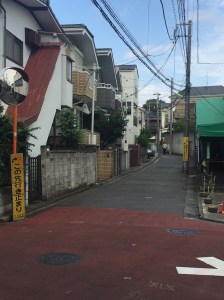
Where now? I headed back toward the station to get my bearings and start again. Without Wi-Fi, I’d been avoiding Google maps, but now, rather than wasting more time, I pulled out my phone, oriented myself, and set out again—only to find that I’d been going in the right direction after all. A short walk to the right under the tracks and straight on from there until I came to a little neighborhood, turn right, then straight down a narrow street lined with little houses. Some appeared to be multi-family, some single family with the tiniest yards. Every home had plants, shrubs, flowers, bicycles propped by gates, stone walls. 

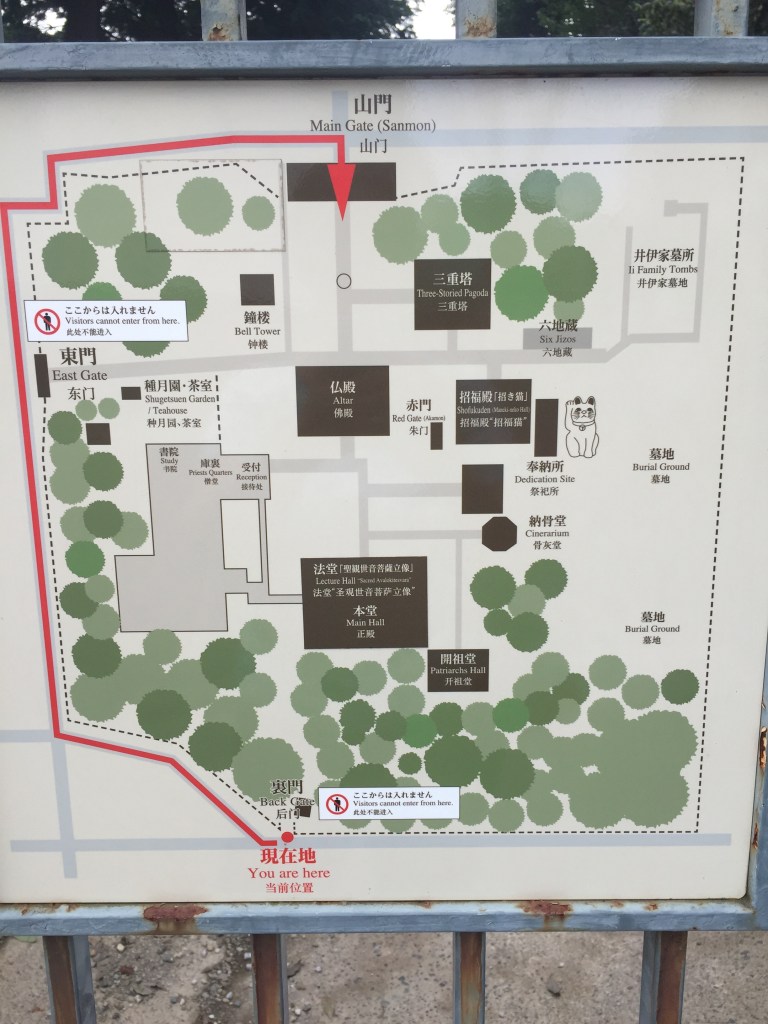
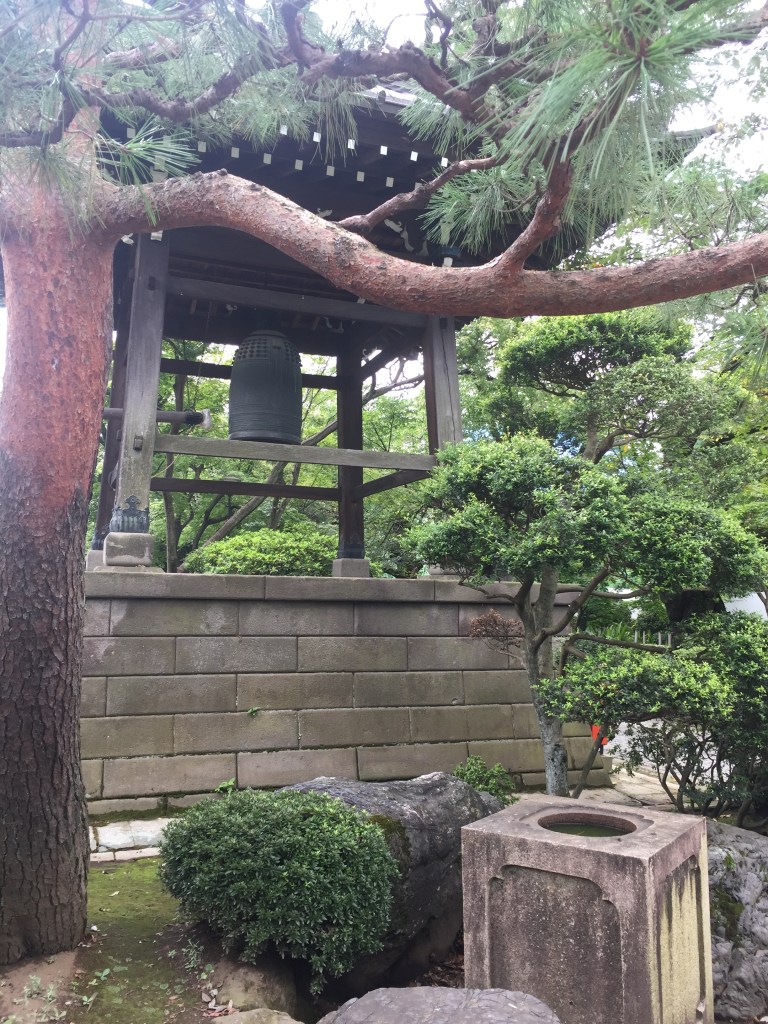
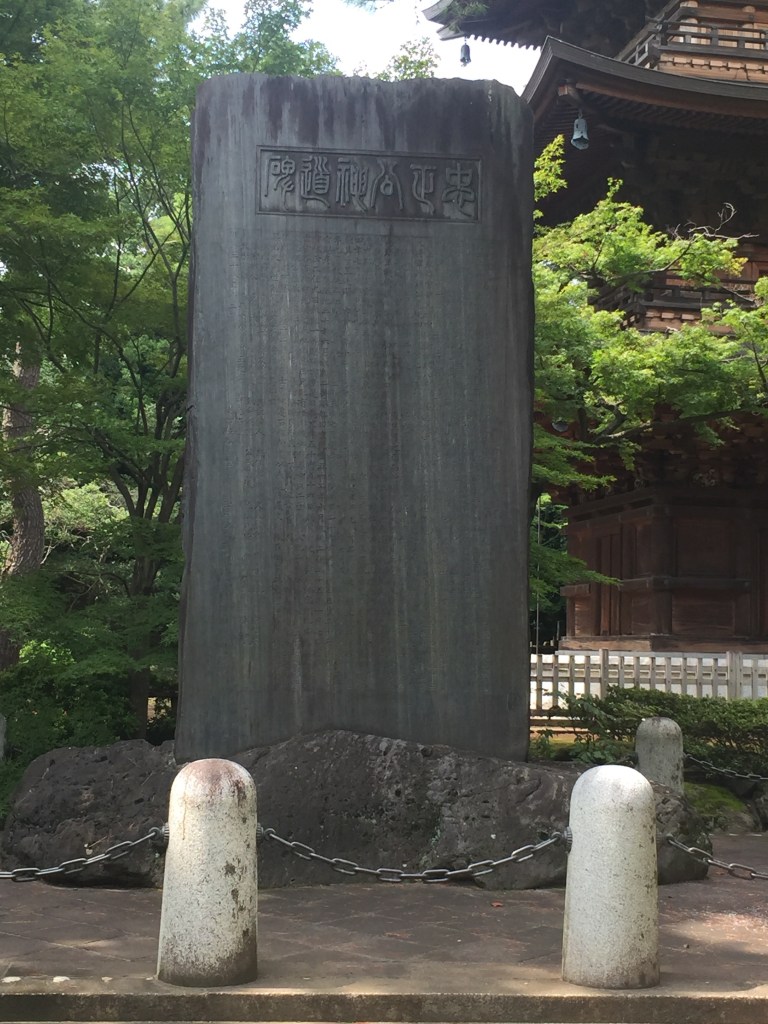
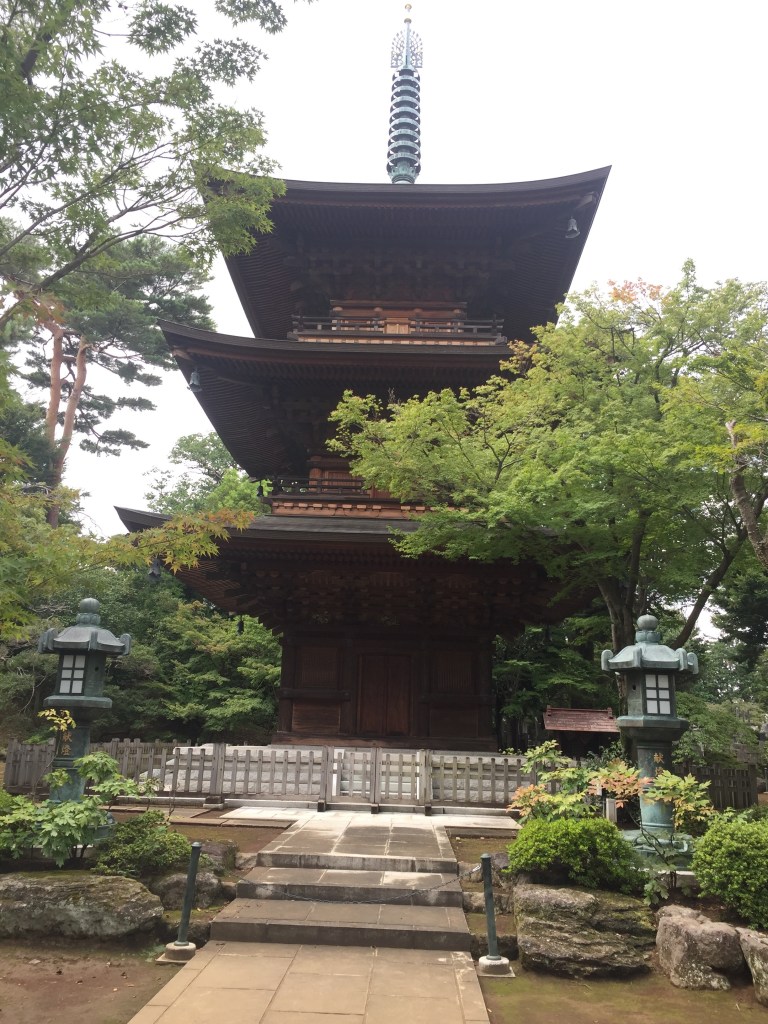
Finally I came to a high wall with a gate and a sign advising me—in English—this is the back of the temple, walk to the left and go to the front. Around another corner, and now before me, the big gate—the main entrance. I walked along a path shaded with trees, passing a 3-tiered pagoda, a tall monument of slate covered in Japanese characters, the temple bell. 

In front of the temple itself, an urn of sand and incense was set in the middle of the walkway.  The lighter wouldn’t light for me, so I waved the smoke hanging in the air above the urn into my face. 

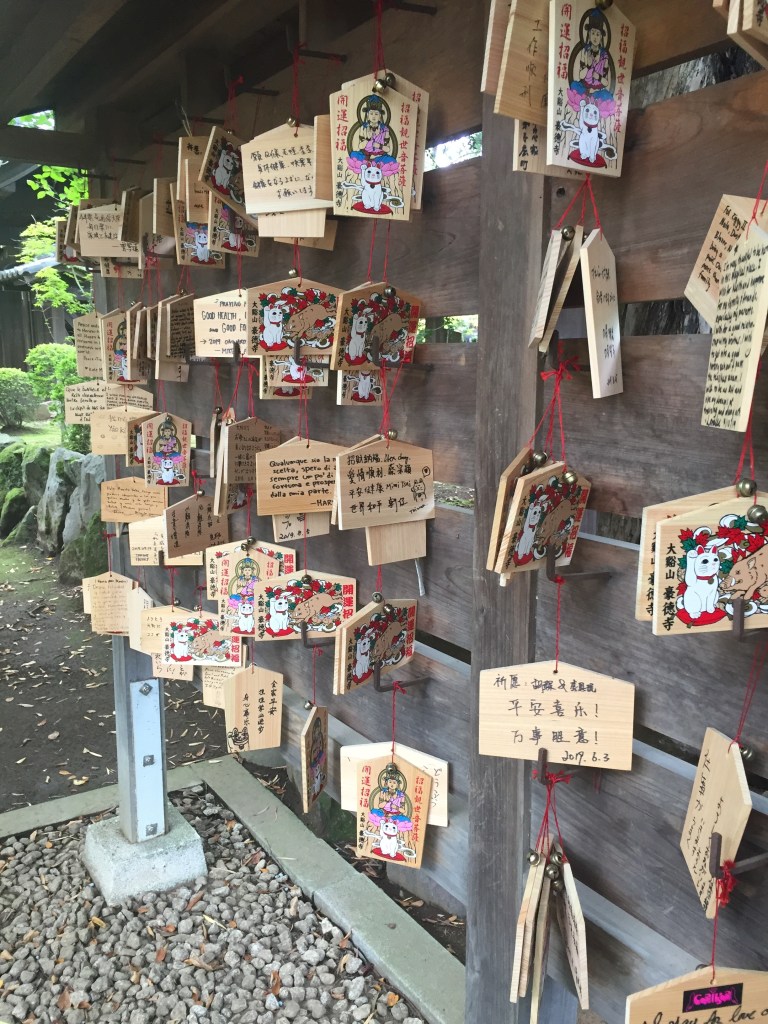
I wandered from building to building. The dark wood and beige stucco of the buildings spoke of the antiquity of the place, inviting me to linger. A few people were heading down a path, and sensing they knew where they were going, I followed along. On my right, a board displayed wooden cards, some written in English, most in Japanese, with prayers and requests for wishes to be granted. Each one carried a picture of the famous cat with paw raised. 

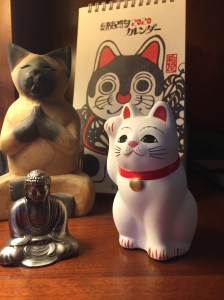
A little further on, I find what I’ve come for. So many cats, from the size of an acorn to very large ones, perhaps a foot tall, all exactly the same. Each representing someone’s wish, granted or hoped for. Some have been there a very long time, now dusted with green algae from the humidity, while others are bright white and new. They cluster around a lordly relaxing bas-relief Buddha who serenely oversees them.

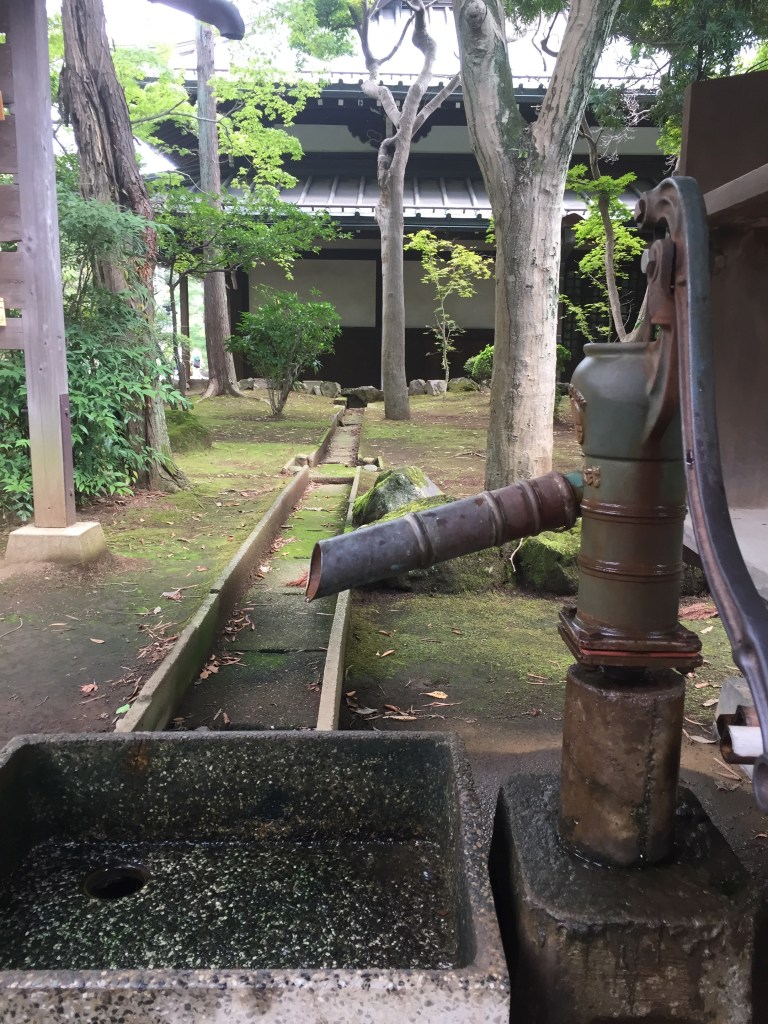
The temple is small; only a few buildings can be entered. Near the main building, a water pump can be worked to send water into a channel; like others, I try pumping and watch the trickle into the channel. In front of the temple building near the cats, people—smiling couples, elders, families—approach, bow, clap hands, pray briefly, bow, pull the bell cord to make it chime, and then wander off.  I do the same, making my wish for health and happiness for my family.

Walking further, I come upon the cemetery, where I wander around looking at the stones, and then nearby, come to the little shop where you can buy a beckoning cat to place at the Dedication Site. I bought cats to bring home to my family, and the smiling lady seemed so happy that I was there as she pressed into my hand an English copy of the beckoning cat’s story. …

A long time ago, the temple was nothing more than a shabby hut where a monk lived on alms and little else. He had a cat he loved as his own child, and one day, he said to the cat, “If you are grateful to me, bring some fortune to the temple.” A long time later, in the summer, a group of Samurai warriors came by. They said, “We were about to pass your gate, but there was a cat crouching and suddenly it lifted its paw and started waving at us, inviting us to rest.” So the monk brought them tea and urged them to relax. Suddenly a thunderstorm sent pouring rain and lightning, forcing them to remain with the monk, who passed the time by preaching to them about the Buddha.  The Samurai, so impressed, told the monk that he was king of a prefecture and because of the cat’s waving, he was able to hear this message, saying “This must be Buddha’s will.” After he returned home, the Samurai donated huge rice fields and croplands to the temple. Because of the cat, fortune came to the temple, which is now called the cat temple. The statue of the cat was established to help people remember the story, and now everybody knows it as a symbol of household serenity, business prosperity, and fulfillment of wishes.

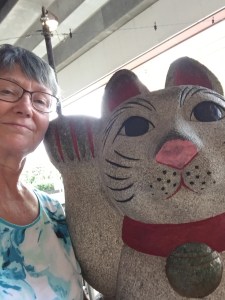
Back at the Gotokuji Station…how did I miss this guy?

Finding the Home of the Good Luck Cat

With almost a year of Pandemic behind us and unable to travel, I dust off memories of our last big trip, to Japan, in August 2019…

We were in Tokyo, and one day, my original plan was to go to Asakusa for the day while my husband was in meetings. I’d been there with him on a previous trip, and I knew I could easily spend hours and hours there among the temples. But dinner plans settled the night before meant that today, I needed to find a simpler option.

Good Luck Cats fill a window near Chinatown, Washington D.C. April 2019

I googled “don’t miss sights Tokyo” and when the list appeared, I skimmed it for a place I’d never been. One caught my eye—Gotokuji—the home of the lucky cat. Some of the reviews said, “Don’t bother—boring and hard to get to”, but others said, “If you love cats, you should go.” I decided to go.

I worked out the route with the help of Google maps: from Shinagawa Station on the Yamamoto line to Shinjuku and there change to Odakyu line to Gotokuji Station, then 15 minute walk to the temple. It sounded like a perfect opportunity to try my place-finding skills in the Tokyo suburbs.

mackerel

After a breakfast of ramen noodles, miso, and a taste of mackerel, among other things, I set out from our hotel. The morning was very hot and humid, and within minutes, I was dripping sweat as I walked to Shinagawa station. 

I caught our accustomed Yamamoto line train to Shinjuku. We’d done this several times already—to go to Shibuya to do the Scramble, to the Kinokuniya bookstore in Shinjuku, and our very first outing, to Shinjuku Gyo-en National Garden. We’d had some challenges finding the garden once we got out of the station that first day, but at this point about a week into our stay, I felt confident. 

Trains running past our hotel in Shinagawa

Everything was going smoothly until I went looking for the Odakyu line. I found myself in another part of the station able to go no further since I’d put my ticket in the entrance machine and it believed my journey was done. Does this mean I have to go out of the station?  I was in complete confusion until I spotted ticket vending for the Odakyu line, where I was able to buy a ticket for Gotokuji, and realized, yes, I had to go out of the station to re-enter for the Odakyu line. 

Going away from Tokyo at late morning, the train was nearly empty.  Arriving at Gotokuji station—just a platform—I headed down some stairs and outside. Now what? I did not see a sign to the temple so I set out in the direction I thought I should go, but the path seemed to go only under the tracks. 

Where now? I headed back toward the station to get my bearings and start again. Without Wi-Fi, I’d been avoiding Google maps, but now, rather than wasting more time, I pulled out my phone, oriented myself, and set out again—only to find that I’d been going in the right direction after all. A short walk to the right under the tracks and straight on from there until I came to a little neighborhood, turn right, then straight down a narrow street lined with little houses. Some appeared to be multi-family, some single family with the tiniest yards. Every home had plants, shrubs, flowers, bicycles propped by gates, stone walls. 

Finally I came to a high wall with a gate and a sign advising me—in English—this is the back of the temple, walk to the left and go to the front. Around another corner, and now before me, the big gate—the main entrance. I walked along a path shaded with trees, passing a 3-tiered pagoda, a tall monument of slate covered in Japanese characters, the temple bell. 

In front of the temple itself, an urn of sand and incense was set in the middle of the walkway.  The lighter wouldn’t light for me, so I waved the smoke hanging in the air above the urn into my face. 

I wandered from building to building. The dark wood and beige stucco of the buildings spoke of the antiquity of the place, inviting me to linger. A few people were heading down a path, and sensing they knew where they were going, I followed along. On my right, a board displayed wooden cards, some written in English, most in Japanese, with prayers and requests for wishes to be granted. Each one carried a picture of the famous cat with paw raised. 

A little further on, I find what I’ve come for. So many cats, from the size of an acorn to very large ones, perhaps a foot tall, all exactly the same. Each representing someone’s wish, granted or hoped for. Some have been there a very long time, now dusted with green algae from the humidity, while others are bright white and new. They cluster around a lordly relaxing bas-relief Buddha who serenely oversees them.

The temple is small; only a few buildings can be entered. Near the main building, a water pump can be worked to send water into a channel; like others, I try pumping and watch the trickle into the channel. In front of the temple building near the cats, people—smiling couples, elders, families—approach, bow, clap hands, pray briefly, bow, pull the bell cord to make it chime, and then wander off.  I do the same, making my wish for health and happiness for my family.

Walking further, I come upon the cemetery, where I wander around looking at the stones, and then nearby, come to the little shop where you can buy a beckoning cat to place at the Dedication Site. I bought cats to bring home to my family, and the smiling lady seemed so happy that I was there as she pressed into my hand an English copy of the beckoning cat’s story. …

A long time ago, the temple was nothing more than a shabby hut where a monk lived on alms and little else. He had a cat he loved as his own child, and one day, he said to the cat, “If you are grateful to me, bring some fortune to the temple.” A long time later, in the summer, a group of Samurai warriors came by. They said, “We were about to pass your gate, but there was a cat crouching and suddenly it lifted its paw and started waving at us, inviting us to rest.” So the monk brought them tea and urged them to relax. Suddenly a thunderstorm sent pouring rain and lightning, forcing them to remain with the monk, who passed the time by preaching to them about the Buddha.  The Samurai, so impressed, told the monk that he was king of a prefecture and because of the cat’s waving, he was able to hear this message, saying “This must be Buddha’s will.” After he returned home, the Samurai donated huge rice fields and croplands to the temple. Because of the cat, fortune came to the temple, which is now called the cat temple. The statue of the cat was established to help people remember the story, and now everybody knows it as a symbol of household serenity, business prosperity, and fulfillment of wishes.

Back at the Gotokuji Station…how did I miss this guy?

At last, a new post

I have not posted here since May.

As April closed, I was focused on all that Covid-19 was stealing from us—visits with family, travel, especially the loss of a trip to London for a Within Temptation concert. I was frustrated with the new complexity of ordinary things like grocery shopping. Nothing was simple any more.

Normally a restless person, always busy, working, running errands, avoiding sitting still, the “new normal” meant I could no longer just get up and go out if I wanted or needed to.

I began working from home in March, and we settled into a routine. That really describes it—routine. Every day became the same—only the words coming out of the talking heads on TV changed from day to day, and after awhile, even they weren’t changing much.

My natural bent is to intellectualize things, and, looking back through my notebooks, I see I was doing just that—trolling the internet to find information so that it would all make sense. I searched out fatality statistics for the flu, for instance, and discovered that the CDC has only provided estimates of flu prevalence and deaths. I needed to contextualize what I was seeing on TV about hospitals over-flowing with patients in NYC; when I drove past our nearby hospital, the traffic around it seemed the same, no long lines of people waiting to get in and even a few empty parking spaces—how could it all be true?

I knew no one who’d become sick. I knew no one who’d been quarantined as possibly sick. Looking at the numbers, with a population of 330 million, and cases only numbering in the tens of thousands, it was clear that most people didn’t know anyone who’d been sick. This increased the unreality of it all.

Then on May 9, I got one of those phone calls.  Someone close to me and about my age was hospitalized with Covid-19. In that moment, I felt I had been pitched into the ocean amidst the Perfect Storm. This person was sick and frightened and I could do nothing to help. Phone calls felt so inadequate as the quavering voice on the other end said, “I’m going to die…” 
The next day, I wrote in my notebook, “Suddenly everything I’ve been doing seems frivolous and silly…before, I was in a bubble. We have been doing what we’re supposed to do—stay home, wear a mask at the grocery, and we have stayed well. And it has induced this illusory sense of well-being, that I am protected. But I am not.”

Suddenly, Covid-19 was real. Not only did I now know someone who was seriously ill with it, but I also received the reality—that it could have been me in the hospital.

Since that day, writing has felt impossible.

I tried working on a few posts in my notebooks, but nothing worked. Nothing clicked. Nothing mattered. I’d read a draft the next day only to pronounce it “not compelling—who would care?” Every time I tried to write, I came up empty.

Despite lockdowns and quarantines, events on the national scene continued to tumble. Increasing case numbers, increasing fatalities, George Floyd, protests, violence, endless political ranting, more violence, more cases, states opening, more lockdowns and protests and violence.

Through it all, writing anything began to feel like a pointless exercise. My efforts to write led me down innumerable rabbit holes, petering out into unfocused drivel. I kept up my daily pages, but they devolved into insignificant chronology and description—what I had for dinner, what my cat was doing, and a lot of “I don’t know what to write” over and over. Then, sometime in the summer, I stopped writing altogether.

The other night, plagued by returning insomnia and trying to avoid that problematic blue light, I opened Natalie Goldberg’s book, Wild Mind. This is where I landed:

“The only failure in writing is when you stop doing it. Then you fail yourself. You affirm your resistance. Don’t do that. Let the outside world scream at you. Create an inner world of determination…”

And here I am today, creating this post. Does this mean I’ve emerged from my paralyzing bout of writer’s block? I doubt it heals so quickly. But maybe I’ve finally found a way into that inner world of determination.

Postscript. 

Yet another tumultuous event happened yesterday, one that strikes close to my heart—the passing of Ruth Bader Ginsburg. On a trip to the Supreme Court with my law school class in 2007, we walked past her office, her door standing wide open. A couple of us lingered there. I craned my neck to see inside, to glimpse her if at all possible. But all I could see was a desk and empty chair. Even so, I felt close to greatness in that moment.

Covid-19 Notepad: The Grocery Trip

Today, we made our first foray to the grocery store after two weeks of self-isolation. In the last two weeks, we have gone out together once for a walk in the woods near our house, and once I drove to the beach a few miles away to go running. Otherwise, the only people we’ve seen have been the talking heads on TV.  

After perhaps too much TV, I awoke this morning on edge about the excursion. It was exciting to think about just getting out of the house (such a change—I used to long a for a day to just stay home), but today, I also worried about what the store would be like, and what might happen to us because we went. 

Our store is a typical, American grocery-extravaganza, always clogged with shoppers—families, twenty-something college kids from the nearby university, couples, moms with babies and kids in tow, elders on scooters. We planned our trip for mid-day on a Wednesday, since normally, on a Wednesday afternoon the store is  deserted. 

Today, when we arrived at the shopping plaza, the parking lot was empty, except for a mob of cars huddled at the grocery store’s end of the lot. It was definitely busier than a normal Wednesday.

Inside, where you grab a cart, a girl in an apron and gloves was wiping down the carts, and she passed one to us. The little dining area where you can usually sit down for a snack from the grab-and-go was blocked, the chairs upside down on the tables. Just beyond the registers, the path to the produce—or the bakery, depending how you look at it—was as congested as ever, with people hovering around the rotisserie chickens and turkey legs, and at the counter, eyeing the cakes and donuts. 

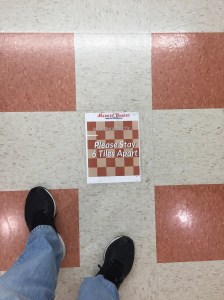
Signs on the floor remind us to keep
our distance.

In the produce department, the crowd did not thin out as I’d expected. The aisles were busy. Some people wore masks, several wore scarves over their faces. Most were alert to the distance between us, and we nervously smiled as we tried to pass each other to get to the avocados. Signs plastered to the floor and across the meat aisle and deli counters helped us remember to keep the six-foot distance in mind.

We had a long list of items we’d been tracking over the last two weeks, for routine meals, particular recipes, or staples we always keep on hand. We were moving quickly through the store, giving wide berth to other shoppers. I am not usually phobic, and generally I enjoy grocery shopping, looking around, investigating new or interesting items. But today, midway through, a sense of foreboding began to rise in me. Just being here so long felt somehow dangerous. I need to get out of here! Our cart was full. It would cost a fortune. It’s time to go. Now.

Finally, we moved to the checkout counter. Here, unlike most days, we did not have to wait. We moved right into a checkout lane, behind a woman with just a few items in her cart. The masked man behind us hung back, easily ten feet away. No rushing to grab a divider to separate orders (in fact, there were no dividers at all). We’ve gotten used to using our own reusable bags—I have a picturesque one from our trip to Germany last summer—but today, no, the bagger said, can’t use those now.

Back at the car, we reorganized the bags into our reusable bags and filled the back of my Forester. In the car, we slathered on the hand sanitizer and drove home.

We need to order a few things online. For some reason, yeast and flour are hot commodities—has everyone begun baking their own bread? And we’ll do without a few things for awhile. And the bill was a shocker, but the pantry is fuller than it’s ever been. And we’re confident we can remain hunkered down for several weeks before we need to do this again.

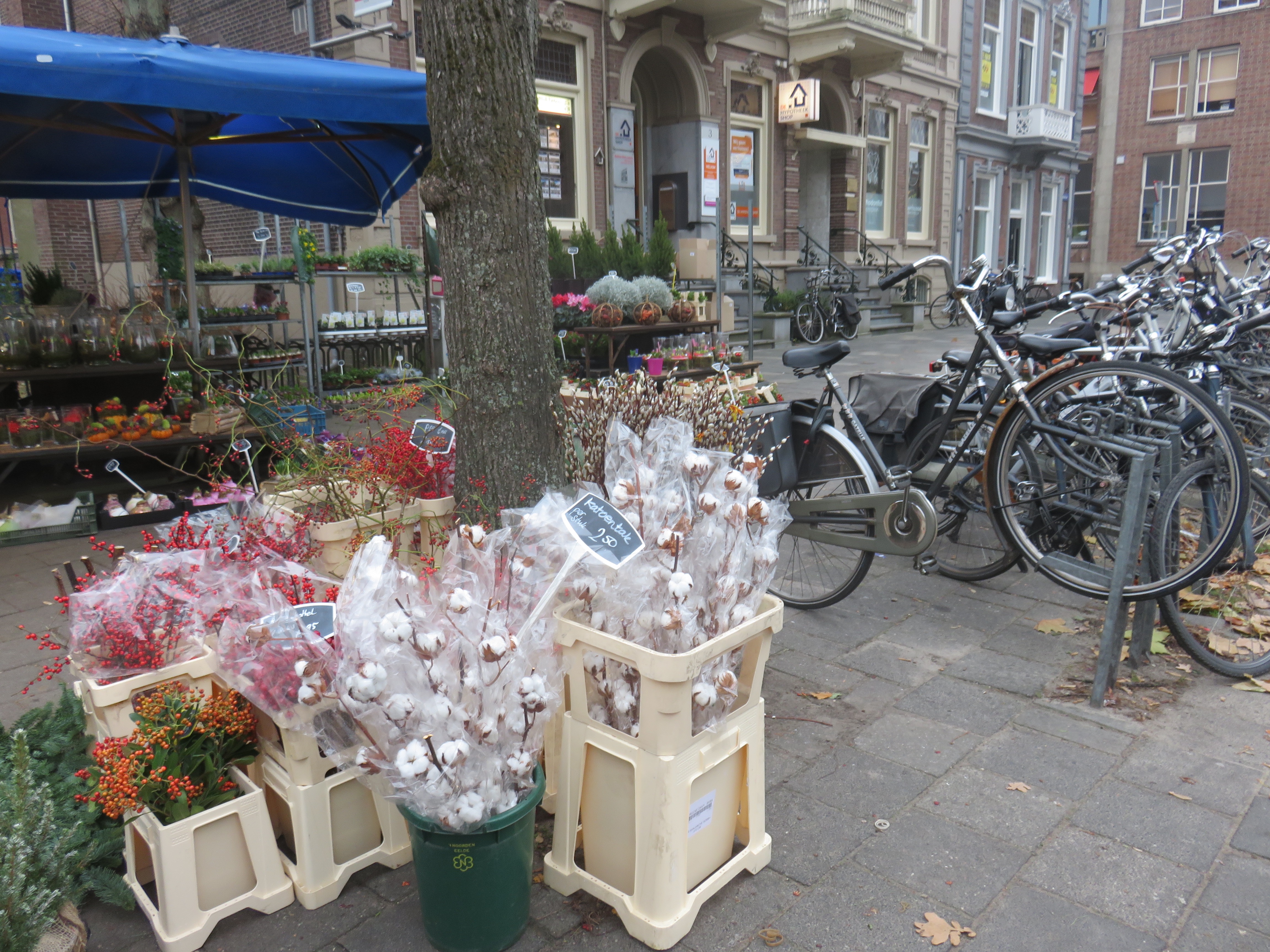
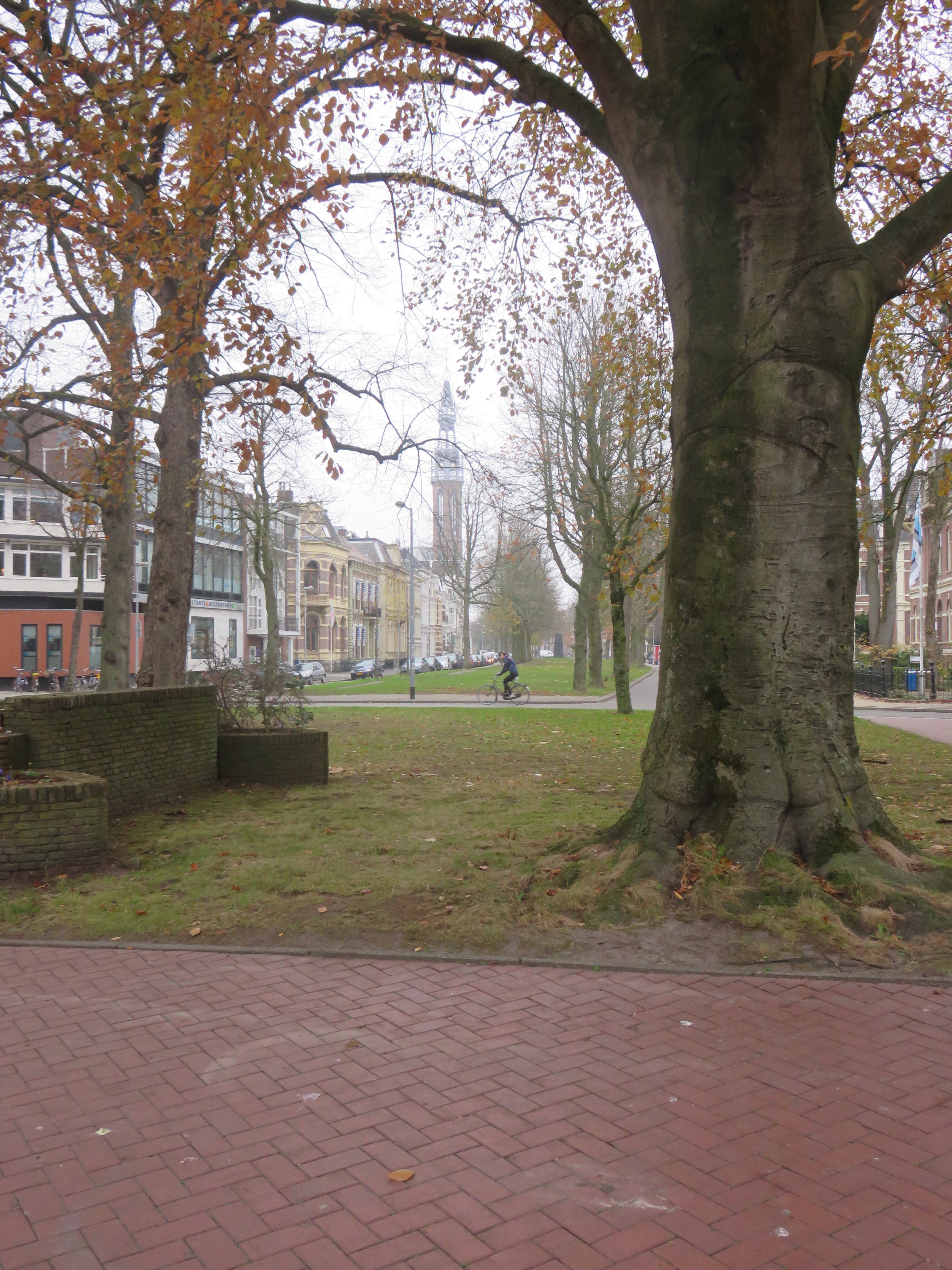
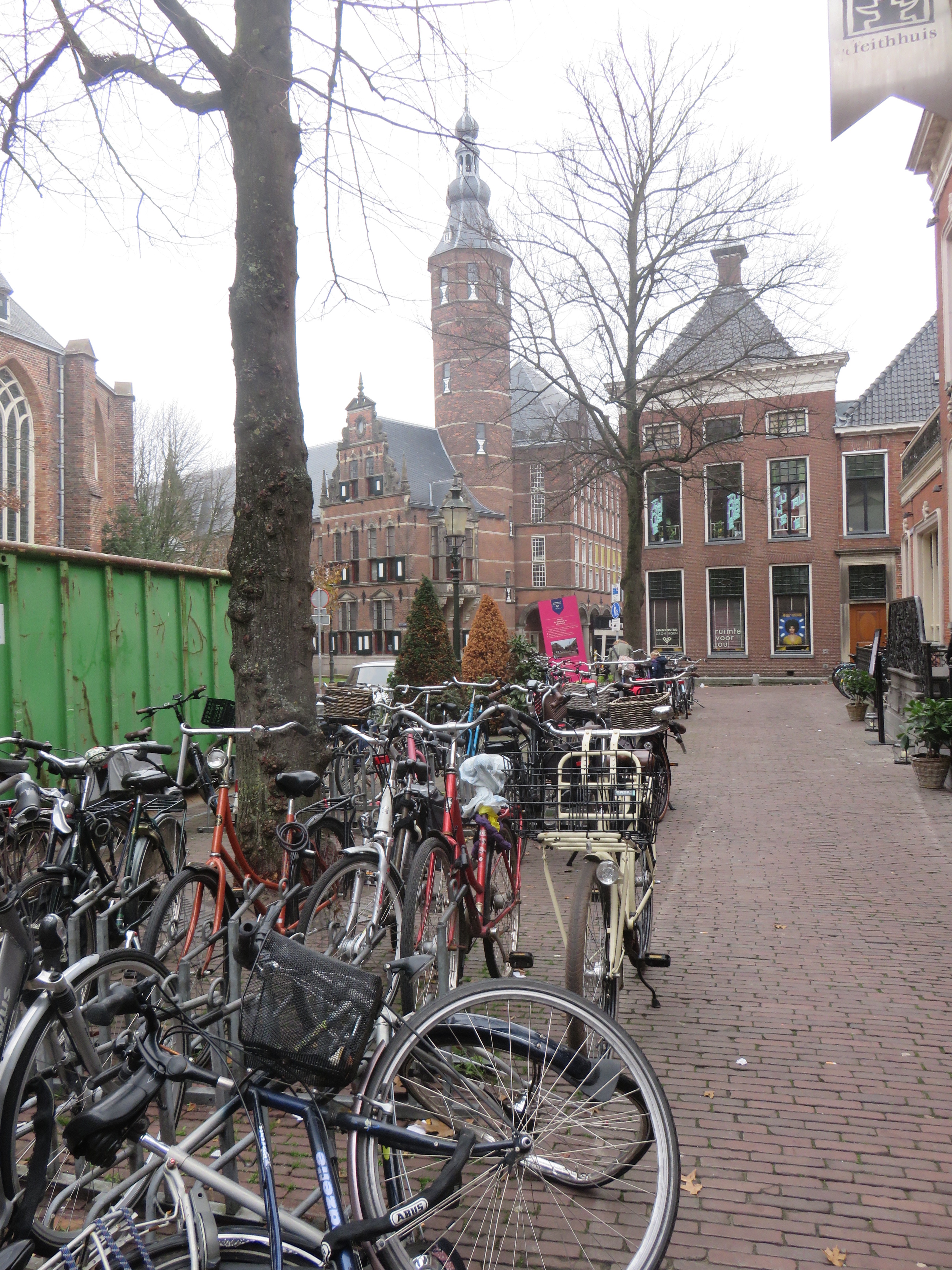
Groningen, Where Everything Changed…

Forget the coronavirus for a few minutes, and come back with me…

I grew up in the Sixties, saw The Beatles on the Ed Sullivan Show, the night before my 10thbirthday, along with 73 million other people. I spent most of my early teenage years with my little transistor radio glued to my ear (it was about the size of my smart phone, but a little thicker). The Beatles went in their direction, and I wandered away. Married in my twenties, we lived briefly in California where I listened to a progressive rock radio station that introduced me to Elvis Costello, Patti Smith, Joan Jett, the Cars, but then we moved again, to northern Maine where the only radio station that appealed to me was public radio. I listened to classical music in the mornings every day, Morning Pro Musica with Robert J. Lurtsema. And then somewhere along the line, even that stopped.

So I was musicless until 2018. Never went to a concert of any type—well, Arthur Fiedler and the Boston Pops came to my hometown while I was in high school; Teresa Stratas, a star singer with the Metropolitan Opera also visited and my mother, desperate to hear her, took me along. And then there was Weird Al, maybe ten years ago, with my daughter. But that’s it. Nothing else. I recall sitting on the stairs in my father’s house, knowing the Monkees (or was it the Beatles? Hard to know, it was so long ago) were in Boston—but that was so far away, and when I was a kid, there was no money for such things.

Fast forward—it’s 2017, and my daughter, Kristin, is fascinated with a band—a Dutch band. The band hadn’t toured in 4 years, and she’d missed them that time, so she said, “Hey Mom, how about we go see Within Temptation? They’re touring again.” “Where?” “Europe”. This of course gave me pause, but  life had changed over the last few years: my husband and I had been traveling a lot; I’d spent a few months in the Netherlands on my own; and a milestone birthday was approaching for my daughter. After some further thought, I agreed.

What had I done? I’m going to the Netherlands to see a symphonic metal band. I don’t even know what that is. My daughter insisted we buy tickets immediately—“They will sell out fast!” A few days later, “I also snagged VIP tickets,” she told me.  Now I am not only going to a metal concert, but I am also going to meet the band. What have I done? Did I mention I was 64 years old at the time? 

With the tickets bought so far ahead, I had time to do my homework, but procrastinator that I am, it was Fall 2018 before I got some CDs and started listening. My daughter had actually played some of the band’s music on a road trip to Maine a few years earlier, so a couple of songs were actually familiar. I asked her about mosh pits—were those a thing to worry about? Not with this band, she assured me. I knew metal music only from headlines and that whole Walmart-banning-explicit-lyrics-thing that happened a while back.

November arrives, and shortly after Thanksgiving, we arrive in Groningen, Netherlands. Our hotel is next to the venue, Martini Plaza. In the evening, we scope it out, make sure we know where to show up for the VIP thing.

On concert day, we appear in the venue lobby, and wait. A small group of others, mostly from around Europe, are also there, and we chat. Most have been following Within Temptation for years, like my daughter.

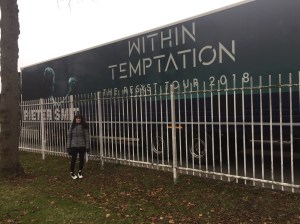
Kristin in front of one of the band’s trailer trucks.

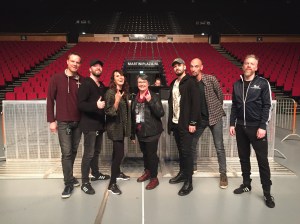
Then we enter the hall where we will first listen to sound check. The singer, Sharon den Adel, is there, soon joined by the other band members. She is dressed in jeans and a comfy jacket and leggings, and she’s tiny, and when she sings, her voice is pure, beautiful, but I understand she is not turning it all on right now, not yet. They come down from the stage, to chat and take pictures. It all feels so natural, strangely ordinary. Ruud Jolie, lead guitarist, says to me, “You’ve never been to a concert and you decide to come to Netherlands to see us as your first?” Yes, indeed!

(L to R) Mike Coolen, Ruud Jolie, Sharon den Adel, me, Stefan
Helleblad, Jeroen van Veen, Martijn Spierenburg
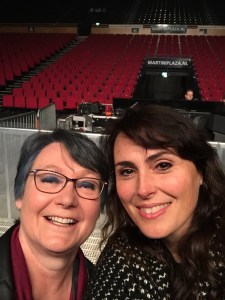
Our selfie, but Sharon had to click the picture!

Following a tour of the backstage area, we take up our spots on the railing in the hall, and wait. Now the waiting is hard. My old feet are feeling it (we—perhaps foolishly—had walked into Groningen in the morning, not wanting to waste a minute.) Tech people are puttering around on the stage. Someone is tuning a guitar—“Is that one of them?” I ask my daughter. “No, just a techie.” Then the lights go down. A momentary hush.

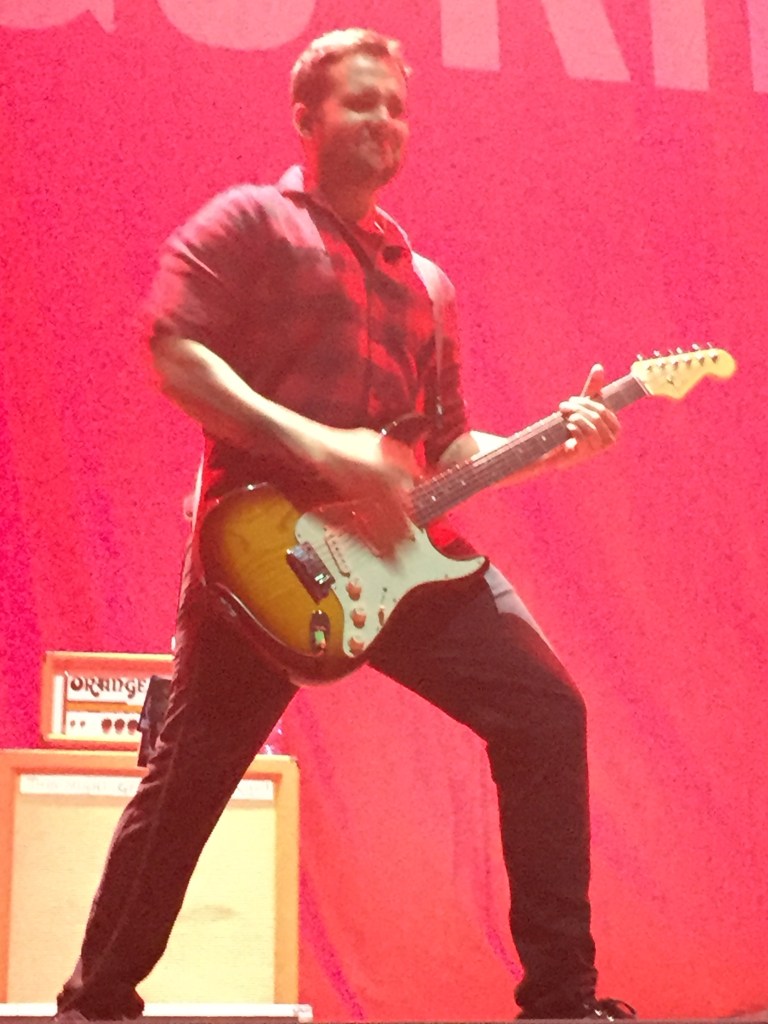
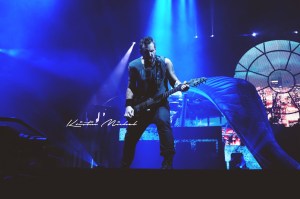
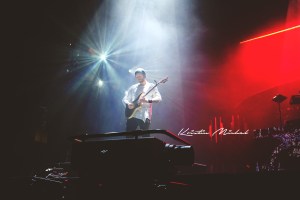
Guitars scream, the bass pounds. Ego Kill Talent takes the stage, wild and crazy, leaping about, stomping, guitars driving, lights flashing from all angles. The music surges through me, like a tsunami, pounding, vibrating my body like I’ve never felt before. I am alive! I can feel it! I have never felt so alive!

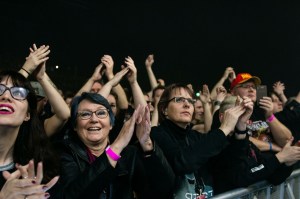
That’s me with the pink wristband (photo by Janne van der Vegt)

Again the lights go up, again we wait, but now everyone is impatient, watching watches, checking phones. At last Within Temptation takes the stage—drummer, keyboardist, guitarists, and finally, Sharon emerges, and the crowd goes wild. Her voice is perfect, and she is radiant. I am teary-eyed. I cannot believe I am here.

I am so close to the stage that I can watch Ruud’s hands on his guitar, I can tell the notes he is playing. The lights are flashing, smoke is pouring from the stage like eruptions, jet blasts, contrails spraying from the floor. The drums—oh, the drums! The pounding is going right through me. I feel the music, and when Sharon sings the lyrical bit at end of Raise Your Banner, my heart is in my throat.

I knew from that moment there is no going back to silence.

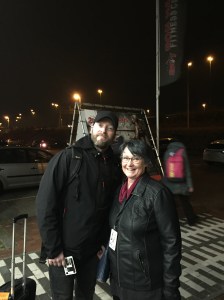
Me with Ruud Jolie after the show–around 2 am