I’ve never been a fan of the standard “Christmas music” and its overworked carols and drummer boys and what not. I’ve always hunted for music that’s a little different. Out of my collection of “holiday” or winter music, assembled over the last 30 years or so (yes, there are few New Age CDs in there, an awful lot of Celtic music, plus one lonely Josh Groban), here are some that sing to me right now.
The most recent addition to my collection isTarja Turunen’sFrom Spirits and Ghosts. Tarja is the former Nightwish vocalist and a true metal goddess, but this album is not what most folks think of when they think “metal”. This was the first Tarja CD I bought last year, because I found her rendition of O Come, O Come Emmanuel online (after discovering her through Within Temptation), and it is hauntingly beautiful (the videois, well, haunting). I have always found Christmas to be a bittersweet holiday, and Tarja captures that perfectly. Operatically trained, Tarja’s soprano is sweet indeed. Try Feliz Navidad.
For more of that moody, bittersweet quality, I love the old folk hymn, I Wonder as I Wander, as sung by Mary Travers of Peter, Paul and Mary, on A Holiday Celebration with the New York Choral Society. This 1988 album is a wonderful collection of less-often-heard songs, including a couple of Hanukkah songs and of course, Blowin’ in the Wind.
A heavy holiday isn’t complete without the Trans-Siberian Orchestra. I’ve had The Lost Christmas CD for many years, but it was buried in the back of the cabinet. So glad I dug it out! I love Siberian Sleigh Ride, but the whole album makes for a real head-banger’s holiday.
We bought Renaissance Holiday (presented by Chip DavisofMannheim Steamroller fame) back when our daughter was in marching band, and imagine our surprise when her band music ( Volte by Praetorius) popped up on one of the tracks! It’s been a favorite holiday CD ever since, always bookended by those other Mannheim Steamroller classics (Mannheim Steamroller Christmas and Christmas Extraordinaire) that are so familiar now.
My list would not be complete without the poignant Christmas in the Trenches, by John McCutcheon. I discovered John McCutcheon’s Winter Solstice when I first crossed into unfamiliar “winter music” territory back in the ’80s. The song tells the true story of the Christmas Truce during World War I. Here’s another take on the Christmas Truce story (as told by Doctor Who).
Lastly, in my continuing hunt for new music, here’s a holiday track, Seasons Change, from Circlefour, a rock band from the Midwest US. They’re pretty new to me, so I’ll have more to say about them in coming posts.
So there you have it–a few of my favorite things, musically speaking, for the holidays.
Helion Prime, a sciency power metal band from California, has a new album out, called Question Everything, and the title song could really be the anthem for some of us these days. Mary Zimmer’s vocals are beautiful (joined on the title track by Heather Michele, their former vocalist), and as I listened, I kept catching interesting lyrics that sent me back to the liner notes for more info. The track that really caught my attention is “Photo 51”; how many other song lyrics do you know that contain the words “research” , “phosphate chain”, and “science”? Not many! (Check out the lyric video, and you can find out why Photo 51 matters—fascinating stuff!) The album is built around a group of science heroes—Albert Einstein, Alan Turing, Rosalind Franklin, Katherine Johnson (sadly the women’s names are less familiar) and others—whose dogged pursuit of truth has advanced our understanding of the universe.
Myrathis an Arabic progressive metal band from Tunisia, recommended by my friend Zaina Arekat (you can check out her music here). Myrath is the first band from their country to sign with a European label. Mostly in their present line-up since 2007, but rooted in 2001 when founder Malek Ben Arbia was 13 years old, Myrath has heavy guitars, strings, cool vocals mixing English and Arabic—all coming together for a fantastic sound. Their most recent album is 2019’s Shehili. Try these beautiful, mysterious videos, “Dance” and “No Holding Back”.
TaleTeller is a Hungarian symphonic metal band that focuses their albums around a single story cycle. Sárközi Edina,their female vocalist, has an exquisite voice. Their new album, The Path, is due out December 21. Check out “Aurora”.
Finally, I cannot deny my regular craving to spin an In Flamesdisc every so often—they’ve really become my go-to band when I need music to make the day better. Lately, it’s Sounds of a Playground Fading. The first time I read the title of the album I knew I would buy it; I could not resist the poetry of the title. This album is among the first of the “new age” In Flames. While I enjoy some unclean vocals and screaming, I do need a good melody and great lyrics. This album points to the new path In Flames has chosen, and I love it. In Flameswe trust!
With almost a year of Pandemic behind us and unable to travel, I dust off memories of our last big trip, to Japan, in August 2019…
We were in Tokyo, and one day, my original plan was to go to Asakusa for the day while my husband was in meetings. I’d been there with him on a previous trip, and I knew I could easily spend hours and hours there among the temples. But dinner plans settled the night before meant that today, I needed to find a simpler option.
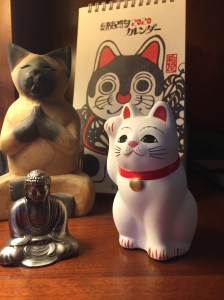
Good Luck Cats fill a window near Chinatown, Washington D.C. April 2019
I googled “don’t miss sights Tokyo” and when the list appeared, I skimmed it for a place I’d never been. One caught my eye—Gotokuji—the home of the lucky cat. Some of the reviews said, “Don’t bother—boring and hard to get to”, but others said, “If you love cats, you should go.” I decided to go.
I worked out the route with the help of Google maps: from Shinagawa Station on the Yamamoto line to Shinjuku and there change to Odakyu line to Gotokuji Station, then 15 minute walk to the temple. It sounded like a perfect opportunity to try my place-finding skills in the Tokyo suburbs.
mackerel
After a breakfast of ramen noodles, miso, and a taste of mackerel, among other things, I set out from our hotel. The morning was very hot and humid, and within minutes, I was dripping sweat as I walked to Shinagawa station.
I caught our accustomed Yamamoto line train to Shinjuku. We’d done this several times already—to go to Shibuya to do the Scramble, to the Kinokuniya bookstore in Shinjuku, and our very first outing, to Shinjuku Gyo-en National Garden. We’d had some challenges finding the garden once we got out of the station that first day, but at this point about a week into our stay, I felt confident.
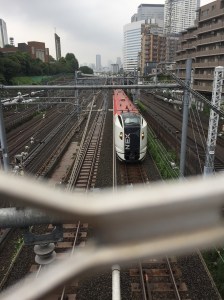
Trains running past our hotel in Shinagawa
Everything was going smoothly until I went looking for the Odakyu line. I found myself in another part of the station able to go no further since I’d put my ticket in the entrance machine and it believed my journey was done. Does this mean I have to go out of the station? I was in complete confusion until I spotted ticket vending for the Odakyu line, where I was able to buy a ticket for Gotokuji, and realized, yes, I had to go out of the station to re-enter for the Odakyu line.
Going away from Tokyo at late morning, the train was nearly empty. Arriving at Gotokuji station—just a platform—I headed down some stairs and outside. Now what? I did not see a sign to the temple so I set out in the direction I thought I should go, but the path seemed to go only under the tracks.
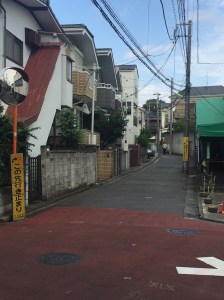
Where now? I headed back toward the station to get my bearings and start again. Without Wi-Fi, I’d been avoiding Google maps, but now, rather than wasting more time, I pulled out my phone, oriented myself, and set out again—only to find that I’d been going in the right direction after all. A short walk to the right under the tracks and straight on from there until I came to a little neighborhood, turn right, then straight down a narrow street lined with little houses. Some appeared to be multi-family, some single family with the tiniest yards. Every home had plants, shrubs, flowers, bicycles propped by gates, stone walls.
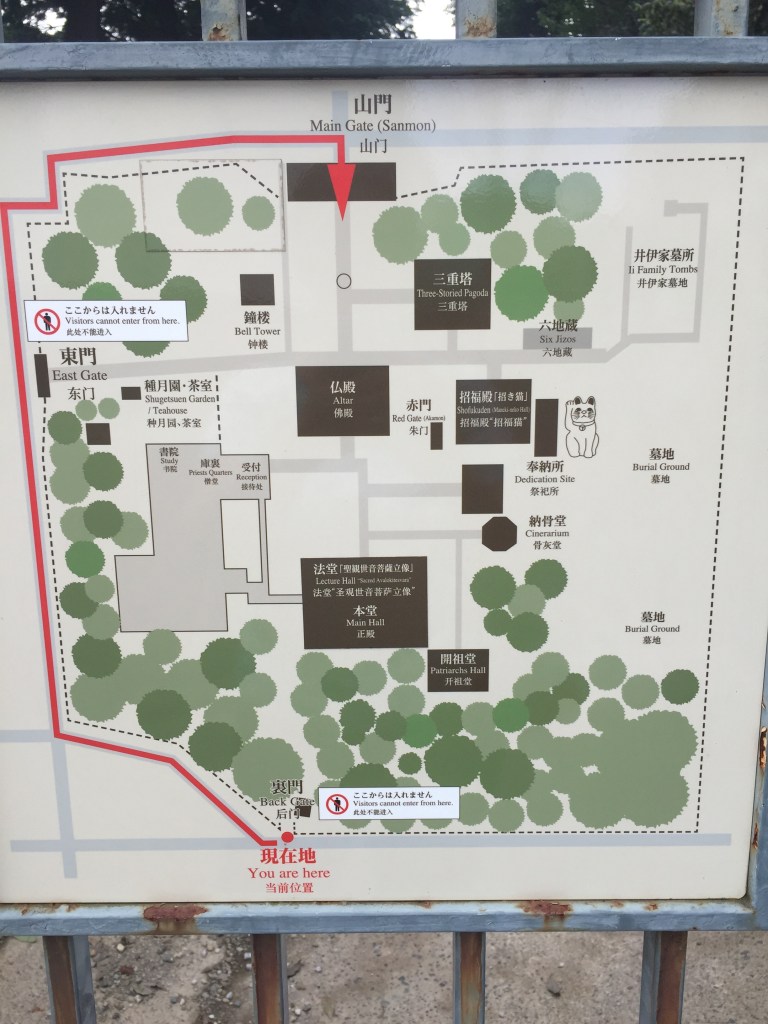
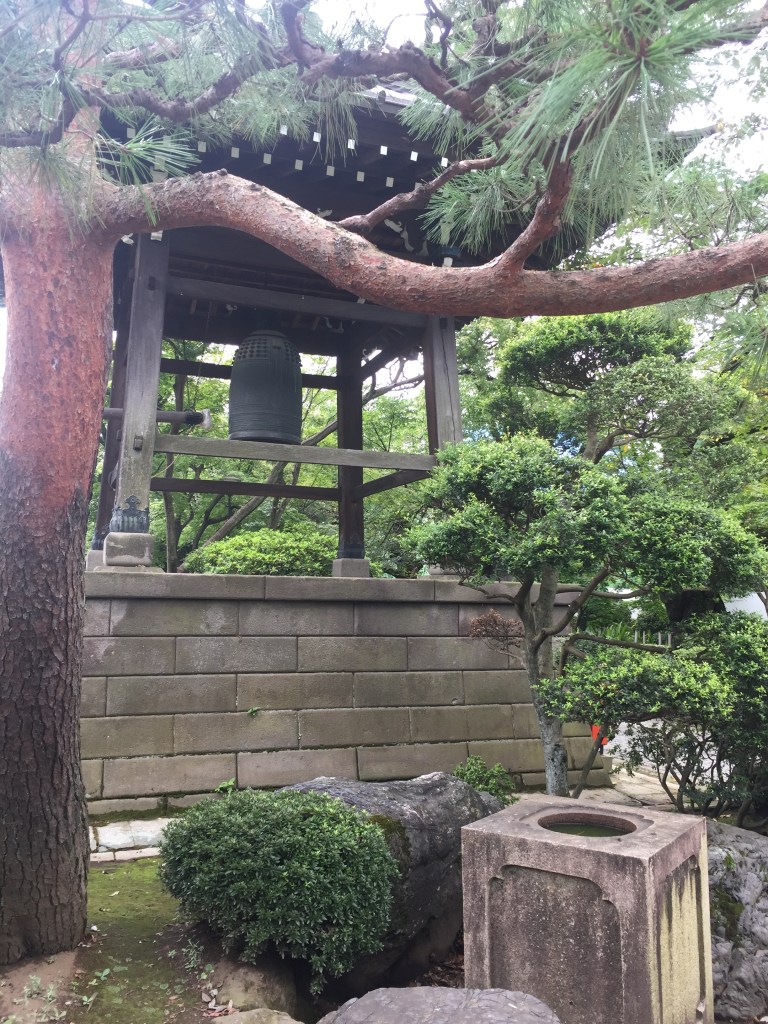
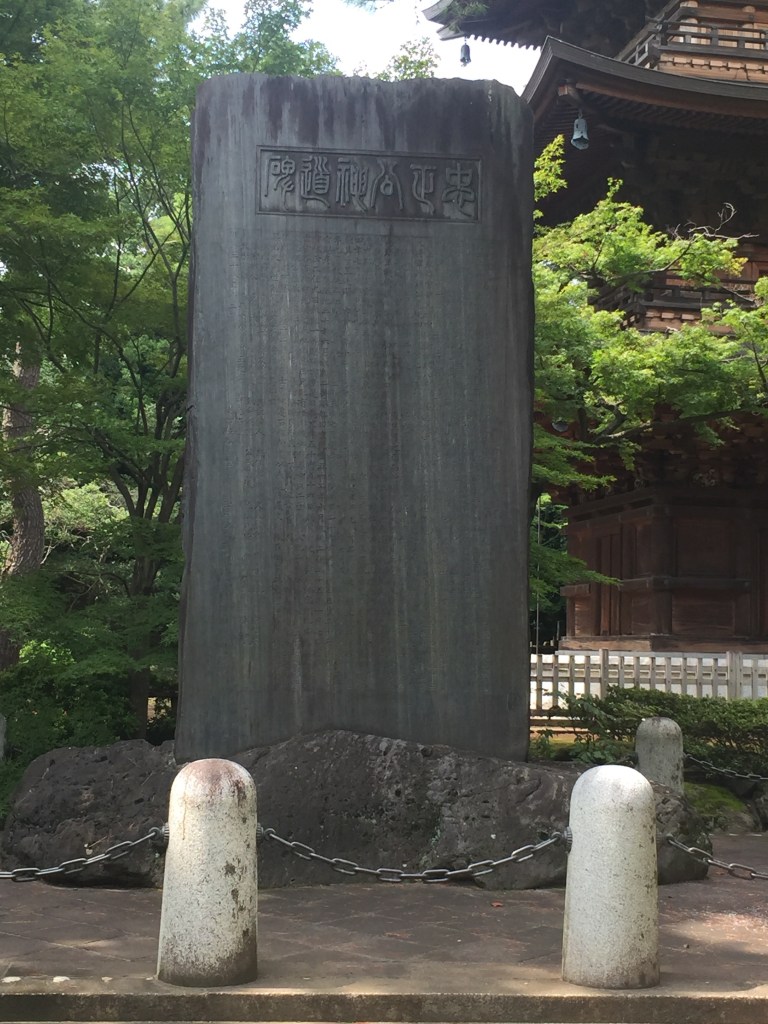
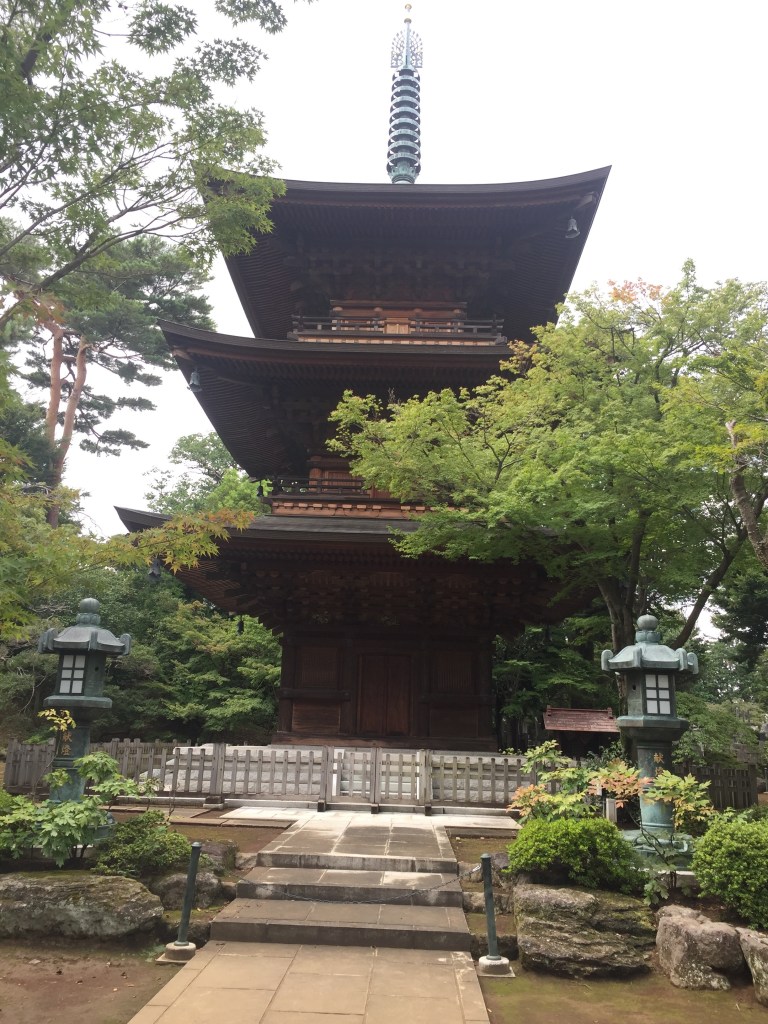
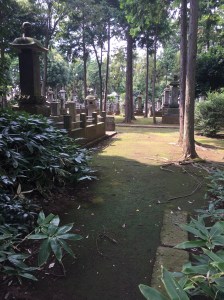
Finally I came to a high wall with a gate and a sign advising me—in English—this is the back of the temple, walk to the left and go to the front. Around another corner, and now before me, the big gate—the main entrance. I walked along a path shaded with trees, passing a 3-tiered pagoda, a tall monument of slate covered in Japanese characters, the temple bell.
In front of the temple itself, an urn of sand and incense was set in the middle of the walkway. The lighter wouldn’t light for me, so I waved the smoke hanging in the air above the urn into my face.
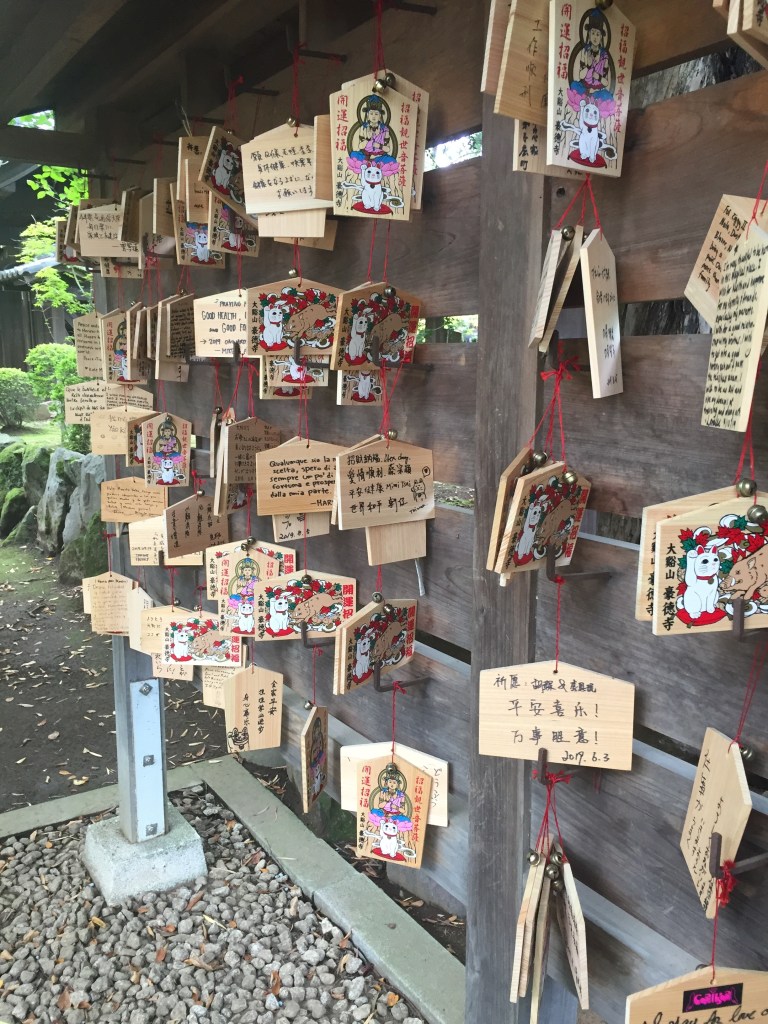
I wandered from building to building. The dark wood and beige stucco of the buildings spoke of the antiquity of the place, inviting me to linger. A few people were heading down a path, and sensing they knew where they were going, I followed along. On my right, a board displayed wooden cards, some written in English, most in Japanese, with prayers and requests for wishes to be granted. Each one carried a picture of the famous cat with paw raised.
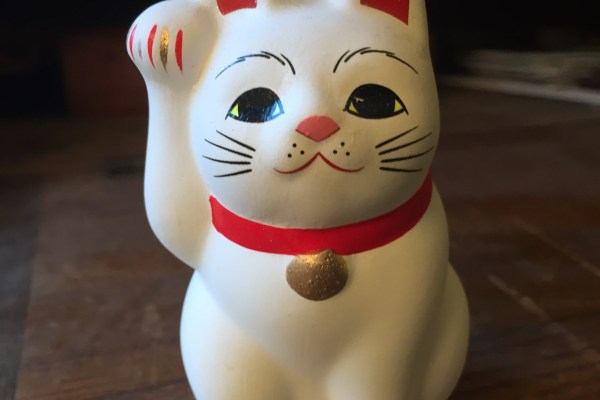
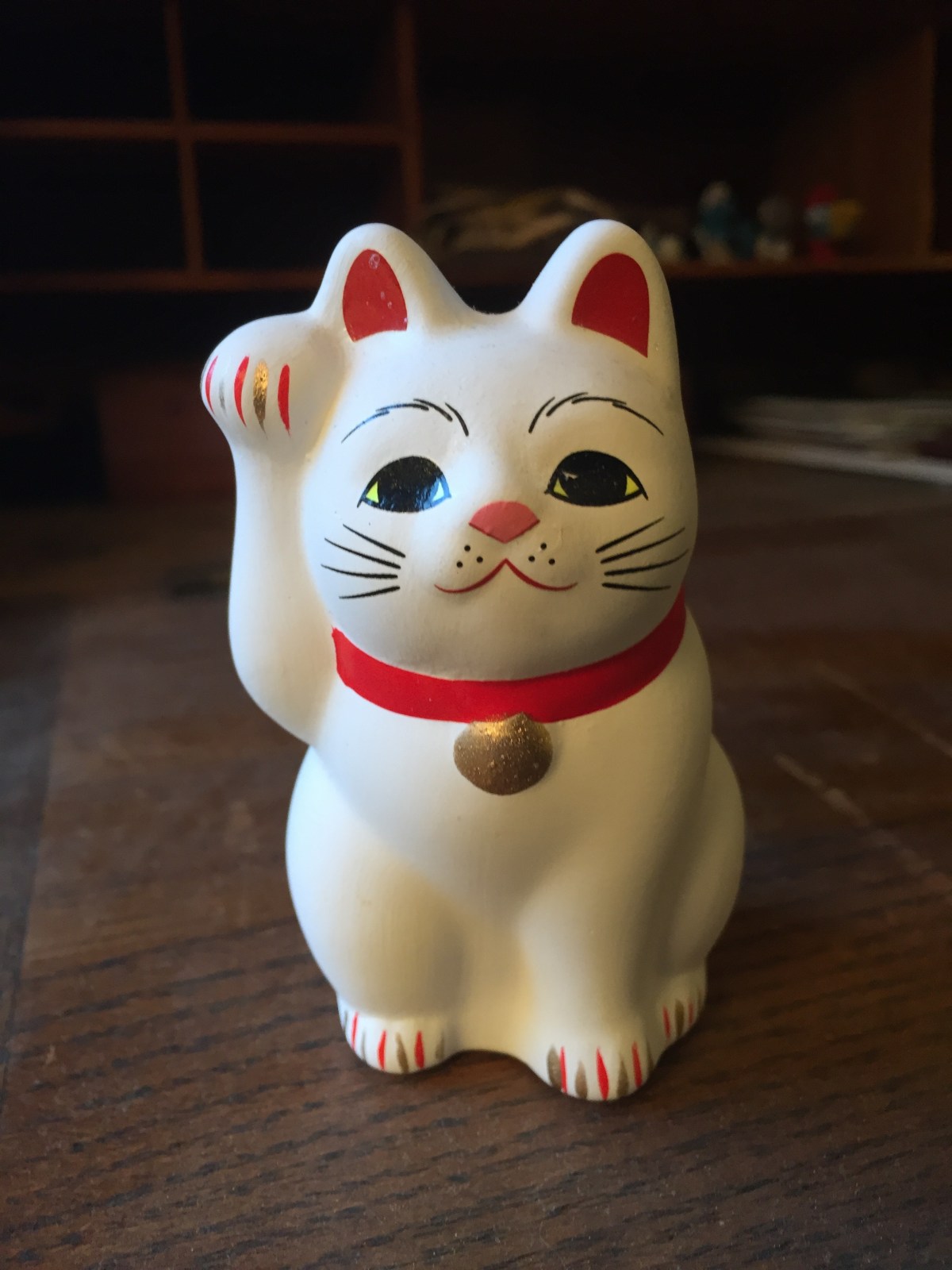
A little further on, I find what I’ve come for. So many cats, from the size of an acorn to very large ones, perhaps a foot tall, all exactly the same. Each representing someone’s wish, granted or hoped for. Some have been there a very long time, now dusted with green algae from the humidity, while others are bright white and new. They cluster around a lordly relaxing bas-relief Buddha who serenely oversees them.
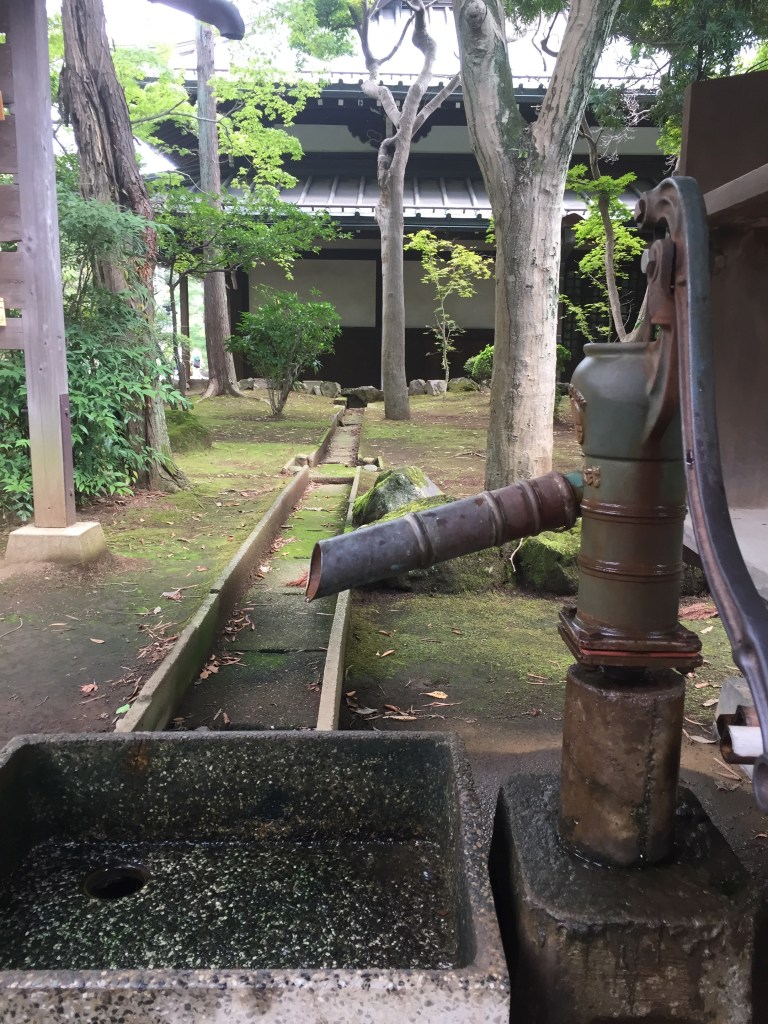
The temple is small; only a few buildings can be entered. Near the main building, a water pump can be worked to send water into a channel; like others, I try pumping and watch the trickle into the channel. In front of the temple building near the cats, people—smiling couples, elders, families—approach, bow, clap hands, pray briefly, bow, pull the bell cord to make it chime, and then wander off. I do the same, making my wish for health and happiness for my family.
Walking further, I come upon the cemetery, where I wander around looking at the stones, and then nearby, come to the little shop where you can buy a beckoning cat to place at the Dedication Site. I bought cats to bring home to my family, and the smiling lady seemed so happy that I was there as she pressed into my hand an English copy of the beckoning cat’s story. …
A long time ago, the temple was nothing more than a shabby hut where a monk lived on alms and little else. He had a cat he loved as his own child, and one day, he said to the cat, “If you are grateful to me, bring some fortune to the temple.” A long time later, in the summer, a group of Samurai warriors came by. They said, “We were about to pass your gate, but there was a cat crouching and suddenly it lifted its paw and started waving at us, inviting us to rest.” So the monk brought them tea and urged them to relax. Suddenly a thunderstorm sent pouring rain and lightning, forcing them to remain with the monk, who passed the time by preaching to them about the Buddha. The Samurai, so impressed, told the monk that he was king of a prefecture and because of the cat’s waving, he was able to hear this message, saying “This must be Buddha’s will.” After he returned home, the Samurai donated huge rice fields and croplands to the temple. Because of the cat, fortune came to the temple, which is now called the cat temple. The statue of the cat was established to help people remember the story, and now everybody knows it as a symbol of household serenity, business prosperity, and fulfillment of wishes.
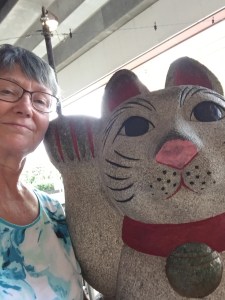
Back at the Gotokuji Station…how did I miss this guy?
With almost a year of Pandemic behind us and unable to travel, I dust off memories of our last big trip, to Japan, in August 2019…
We were in Tokyo, and one day, my original plan was to go to Asakusa for the day while my husband was in meetings. I’d been there with him on a previous trip, and I knew I could easily spend hours and hours there among the temples. But dinner plans settled the night before meant that today, I needed to find a simpler option.
Good Luck Cats fill a window near Chinatown, Washington D.C. April 2019
I googled “don’t miss sights Tokyo” and when the list appeared, I skimmed it for a place I’d never been. One caught my eye—Gotokuji—the home of the lucky cat. Some of the reviews said, “Don’t bother—boring and hard to get to”, but others said, “If you love cats, you should go.” I decided to go.
I worked out the route with the help of Google maps: from Shinagawa Station on the Yamamoto line to Shinjuku and there change to Odakyu line to Gotokuji Station, then 15 minute walk to the temple. It sounded like a perfect opportunity to try my place-finding skills in the Tokyo suburbs.
mackerel
After a breakfast of ramen noodles, miso, and a taste of mackerel, among other things, I set out from our hotel. The morning was very hot and humid, and within minutes, I was dripping sweat as I walked to Shinagawa station.
I caught our accustomed Yamamoto line train to Shinjuku. We’d done this several times already—to go to Shibuya to do the Scramble, to the Kinokuniya bookstore in Shinjuku, and our very first outing, to Shinjuku Gyo-en National Garden. We’d had some challenges finding the garden once we got out of the station that first day, but at this point about a week into our stay, I felt confident.
Trains running past our hotel in Shinagawa
Everything was going smoothly until I went looking for the Odakyu line. I found myself in another part of the station able to go no further since I’d put my ticket in the entrance machine and it believed my journey was done. Does this mean I have to go out of the station? I was in complete confusion until I spotted ticket vending for the Odakyu line, where I was able to buy a ticket for Gotokuji, and realized, yes, I had to go out of the station to re-enter for the Odakyu line.
Going away from Tokyo at late morning, the train was nearly empty. Arriving at Gotokuji station—just a platform—I headed down some stairs and outside. Now what? I did not see a sign to the temple so I set out in the direction I thought I should go, but the path seemed to go only under the tracks.
Where now? I headed back toward the station to get my bearings and start again. Without Wi-Fi, I’d been avoiding Google maps, but now, rather than wasting more time, I pulled out my phone, oriented myself, and set out again—only to find that I’d been going in the right direction after all. A short walk to the right under the tracks and straight on from there until I came to a little neighborhood, turn right, then straight down a narrow street lined with little houses. Some appeared to be multi-family, some single family with the tiniest yards. Every home had plants, shrubs, flowers, bicycles propped by gates, stone walls.
Finally I came to a high wall with a gate and a sign advising me—in English—this is the back of the temple, walk to the left and go to the front. Around another corner, and now before me, the big gate—the main entrance. I walked along a path shaded with trees, passing a 3-tiered pagoda, a tall monument of slate covered in Japanese characters, the temple bell.
In front of the temple itself, an urn of sand and incense was set in the middle of the walkway. The lighter wouldn’t light for me, so I waved the smoke hanging in the air above the urn into my face.
I wandered from building to building. The dark wood and beige stucco of the buildings spoke of the antiquity of the place, inviting me to linger. A few people were heading down a path, and sensing they knew where they were going, I followed along. On my right, a board displayed wooden cards, some written in English, most in Japanese, with prayers and requests for wishes to be granted. Each one carried a picture of the famous cat with paw raised.
A little further on, I find what I’ve come for. So many cats, from the size of an acorn to very large ones, perhaps a foot tall, all exactly the same. Each representing someone’s wish, granted or hoped for. Some have been there a very long time, now dusted with green algae from the humidity, while others are bright white and new. They cluster around a lordly relaxing bas-relief Buddha who serenely oversees them.
The temple is small; only a few buildings can be entered. Near the main building, a water pump can be worked to send water into a channel; like others, I try pumping and watch the trickle into the channel. In front of the temple building near the cats, people—smiling couples, elders, families—approach, bow, clap hands, pray briefly, bow, pull the bell cord to make it chime, and then wander off. I do the same, making my wish for health and happiness for my family.
Walking further, I come upon the cemetery, where I wander around looking at the stones, and then nearby, come to the little shop where you can buy a beckoning cat to place at the Dedication Site. I bought cats to bring home to my family, and the smiling lady seemed so happy that I was there as she pressed into my hand an English copy of the beckoning cat’s story. …
A long time ago, the temple was nothing more than a shabby hut where a monk lived on alms and little else. He had a cat he loved as his own child, and one day, he said to the cat, “If you are grateful to me, bring some fortune to the temple.” A long time later, in the summer, a group of Samurai warriors came by. They said, “We were about to pass your gate, but there was a cat crouching and suddenly it lifted its paw and started waving at us, inviting us to rest.” So the monk brought them tea and urged them to relax. Suddenly a thunderstorm sent pouring rain and lightning, forcing them to remain with the monk, who passed the time by preaching to them about the Buddha. The Samurai, so impressed, told the monk that he was king of a prefecture and because of the cat’s waving, he was able to hear this message, saying “This must be Buddha’s will.” After he returned home, the Samurai donated huge rice fields and croplands to the temple. Because of the cat, fortune came to the temple, which is now called the cat temple. The statue of the cat was established to help people remember the story, and now everybody knows it as a symbol of household serenity, business prosperity, and fulfillment of wishes.
Back at the Gotokuji Station…how did I miss this guy?
As April closed, I was focused on all that Covid-19 was stealing from us—visits with family, travel, especially the loss of a trip to London for a Within Temptation concert. I was frustrated with the new complexity of ordinary things like grocery shopping. Nothing was simple any more.
Normally a restless person, always busy, working, running errands, avoiding sitting still, the “new normal” meant I could no longer just get up and go out if I wanted or needed to.
I began working from home in March, and we settled into a routine. That really describes it—routine. Every day became the same—only the words coming out of the talking heads on TV changed from day to day, and after awhile, even they weren’t changing much.
My natural bent is to intellectualize things, and, looking back through my notebooks, I see I was doing just that—trolling the internet to find information so that it would all make sense. I searched out fatality statistics for the flu, for instance, and discovered that the CDC has only provided estimates of flu prevalence and deaths. I needed to contextualize what I was seeing on TV about hospitals over-flowing with patients in NYC; when I drove past our nearby hospital, the traffic around it seemed the same, no long lines of people waiting to get in and even a few empty parking spaces—how could it all be true?
I knew no one who’d become sick. I knew no one who’d been quarantined as possibly sick. Looking at the numbers, with a population of 330 million, and cases only numbering in the tens of thousands, it was clear that most people didn’t know anyone who’d been sick. This increased the unreality of it all.
Then on May 9, I got one of those phone calls. Someone close to me and about my age was hospitalized with Covid-19. In that moment, I felt I had been pitched into the ocean amidst the Perfect Storm. This person was sick and frightened and I could do nothing to help. Phone calls felt so inadequate as the quavering voice on the other end said, “I’m going to die…”
The next day, I wrote in my notebook, “Suddenly everything I’ve been doing seems frivolous and silly…before, I was in a bubble. We have been doing what we’re supposed to do—stay home, wear a mask at the grocery, and we have stayed well. And it has induced this illusory sense of well-being, that I am protected. But I am not.”
Suddenly, Covid-19 was real. Not only did I now know someone who was seriously ill with it, but I also received the reality—that it could have been me in the hospital.
Since that day, writing has felt impossible.
I tried working on a few posts in my notebooks, but nothing worked. Nothing clicked. Nothing mattered. I’d read a draft the next day only to pronounce it “not compelling—who would care?” Every time I tried to write, I came up empty.
Despite lockdowns and quarantines, events on the national scene continued to tumble. Increasing case numbers, increasing fatalities, George Floyd, protests, violence, endless political ranting, more violence, more cases, states opening, more lockdowns and protests and violence.
Through it all, writing anything began to feel like a pointless exercise. My efforts to write led me down innumerable rabbit holes, petering out into unfocused drivel. I kept up my daily pages, but they devolved into insignificant chronology and description—what I had for dinner, what my cat was doing, and a lot of “I don’t know what to write” over and over. Then, sometime in the summer, I stopped writing altogether.
The other night, plagued by returning insomnia and trying to avoid that problematic blue light, I opened Natalie Goldberg’s book, Wild Mind. This is where I landed:
“The only failure in writing is when you stop doing it. Then you fail yourself. You affirm your resistance. Don’t do that. Let the outside world scream at you. Create an inner world of determination…”
And here I am today, creating this post. Does this mean I’ve emerged from my paralyzing bout of writer’s block? I doubt it heals so quickly. But maybe I’ve finally found a way into that inner world of determination.
Postscript.
Yet another tumultuous event happened yesterday, one that strikes close to my heart—the passing of Ruth Bader Ginsburg. On a trip to the Supreme Court with my law school class in 2007, we walked past her office, her door standing wide open. A couple of us lingered there. I craned my neck to see inside, to glimpse her if at all possible. But all I could see was a desk and empty chair. Even so, I felt close to greatness in that moment.
The media has been much concerned of late with the idea of re-opening the economy, as states begin to dial back their stay-at-home orders and lockdowns. We were told these would “flatten the curve” and protect the healthcare system from a fatal crash. We have hunkered down to slow the spread of the virus. The deaths—of friends, acquaintances, loved ones, the bodies bagged and stacked in makeshift morgues—have terrified us, motivated us to stay in, stay home.
As we hunkered down, bans on large gatherings were among the first social distancing strategies put in place. Now it’s been suggested that such gatherings may not be allowed this year. Suppose, for the sake of argument, the bans on gatherings of 10, or 100, people remain in place for a year, two years, or longer. As we shrink our worlds to avoid the risk of infection, what becomes of concerts, performances, readings and so many other events, and the artists and artist communities that these support?
There was a time when this would have mattered less to me. I wasn’t going out to events much. But that trek to Groningen, Netherlands, to my first live rock concert ever, drastically changed my perspective. We were welcomed into a community—the metal community—where we stood shoulder to shoulder, hands raised, utterly carefree and full of life, singing the songs together as though we were singing hymns in church. What becomes of this community if we can no longer gather?
Large gatherings like this, whether 20 people for a poetry reading or 20,000 for a heavy metal concert, are intrinsic to every arts community.
If we have learned nothing else from our national experiment with Zoom meetings, it is that in-person is just better, whether it’s a meeting with colleagues, a trip to the ballgame or a concert. Relegated to the camera’s view, we lose a powerful world of nuance and non-verbal cues, of closeness and camaraderie. But perhaps especially for art, it is that personal, real-time experience shared with others of like mind that cements our relationships and unites us into community.
While community brings people together, it also serves a another purpose. Communities sustain the artists around which they form, and the music community is no different. Indeed, artists and their art-making have generated vibrant communities around the world, helping to reinvigorate cities everywhere and making arts a vital economic engine that can help ensure the continuation of independent artists making art for the joy of making art.
If we lose large gatherings, we risk losing the arts. The sustenance these large gatherings provide to artists—emotional, professional, financial—can vanish if performance venues can’t survive the new normal.
Without a question, even in a strong economy, arts are a tough way to make a living. A lot of parents, despite buying all those music and dance lessons, have pushed kids away from careers in the arts, telling their budding photographers and dancers, “You won’t be able to support yourself.”
This economic reality is a fact of the music world, where touring is a way of life for bands, who depend on tours to generate income. For heavy metal, historically, this has been especially true, since metal has tended not to get the radio play enjoyed by other musical genres (a topic of its own, outside the scope of this post). Few bands have the stamina and sustained creativity, to reach that elite world of musical nirvana where significant money is to be made. Before the pandemic had even started to unhinge our world view, Kobra Paige, of Kobra and the Lotus, talked about the economic realities she and her band face.
For our part as fans, we stand to lose a kind of sustenance too. We will lose the exhilarating experience of live concerts. I went so long without them, but now, reawakened, I crave them. I think about the concerts I’ve been to in the last year, that excitement, that feeling of being a part of this big, crazy family. We fed on the bands’ energy, just as the bands fed off ours to keep them going, night after night.
Vaccines and antibody tests already in development, contact-tracing tools like apps, and other public health strategies, if they work, might permit a return to large gatherings. Vaccines are undergoing trials in several countries. Apps are in development that will allow discovery of every person who stood within 2 feet of you; China has a version, UK is about to unveil one. In the US, approaches like these will encounter significant roadblocks due, for example, to our willingness to tolerate distrust in science, or to our laser focus on individual rights to privacy at the expense of the public good. From another perspective, the fear is that these strategies would “coerce” people into trying to catch the disease.
If we want to return to even a semblance of normalcy, we need to weigh our responses to public health tools and strategies with our common good in mind. We need to think about the impact of our personal decisions on others and on the communities we care about. We can no longer think solely of ourselves and our individual happiness. We must understand, now more than ever, that our happiness and well-being are tied directly to the happiness and well-being of others.
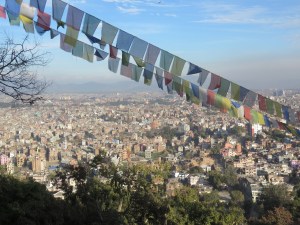
Kathmandu, Nepal, is a mystical place, one I never imagined I would visit. But in January 2015, when my husband began his term as president of IEEE, he was invited to attend some meetings there, and I was invited to join him. Then, three months after our visit, on April 25, the earthquake struck, centered about 50 miles from Kathmandu, killing 9,000 people and destroying innumerable structures in and around Kathmandu. Aftershocks continued throughout the week.
This is one of the ways travel changes us. When the earthquake and tsunami struck Japan in 2011, when Typhoon Haiyan ravaged the Philippines in 2013, I was saddened to learn about them, but they did not cut to the core as the 2015 Nepali earthquake did–I had not yet visited these places. The Nepali earthquake left me sad for days.
When you travel to a country, meet the people, look in their eyes, share a meal with them–it changes you and your perception of them. You learn they are just like you, wanting to live their lives in peace and raise their families. And when disaster strikes, they hurt, and now–since they have become in some sense “real”–you feel their pain in a deeper, more real way.
And so, remembering the earthquake this week, five years later, I’m remembering Nepal.
Approaching Kathmandu
Our trip to Nepal began with a brief stop in Mumbai; meeting had been added to my husband’s itinerary. At dinner, I met someone who had just come from Kathmandu. Having traveled little at that point and accustomed to cities like New York and London, I innocently asked him, “Is it walkable?” He smiled and answered, “You could say that.”
Hotel Soaltee, Kathmandu
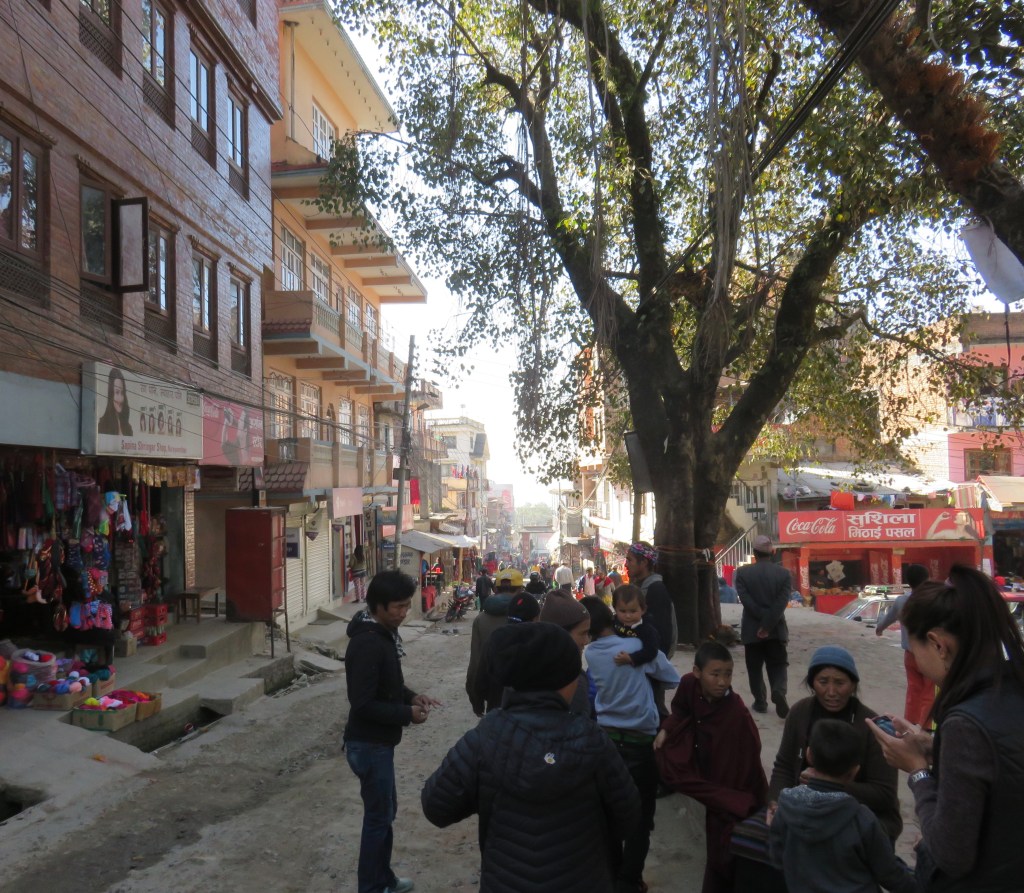
Arriving in Kathmandu, a taxi collected us for the trip to the hotel. I watched Kathmandu rattle by. No multi-lane highway here, just roads congested with vehicles–picture your favorite bumper-to-bumper traffic jam, but it’s all small cars (no trucks at all, pick-up or otherwise), and it’s moving steadily (more or less) at about 30 miles an hour. And instead of pavement, it’s a dirt road, rutted and bumpy. Add to this, a hundred motorcycles, all weaving in among the cars, zipping in and out, many with two riders, often with two adults and a child between. By the way, they’re all wearing helmets. That’s Kathmandu.
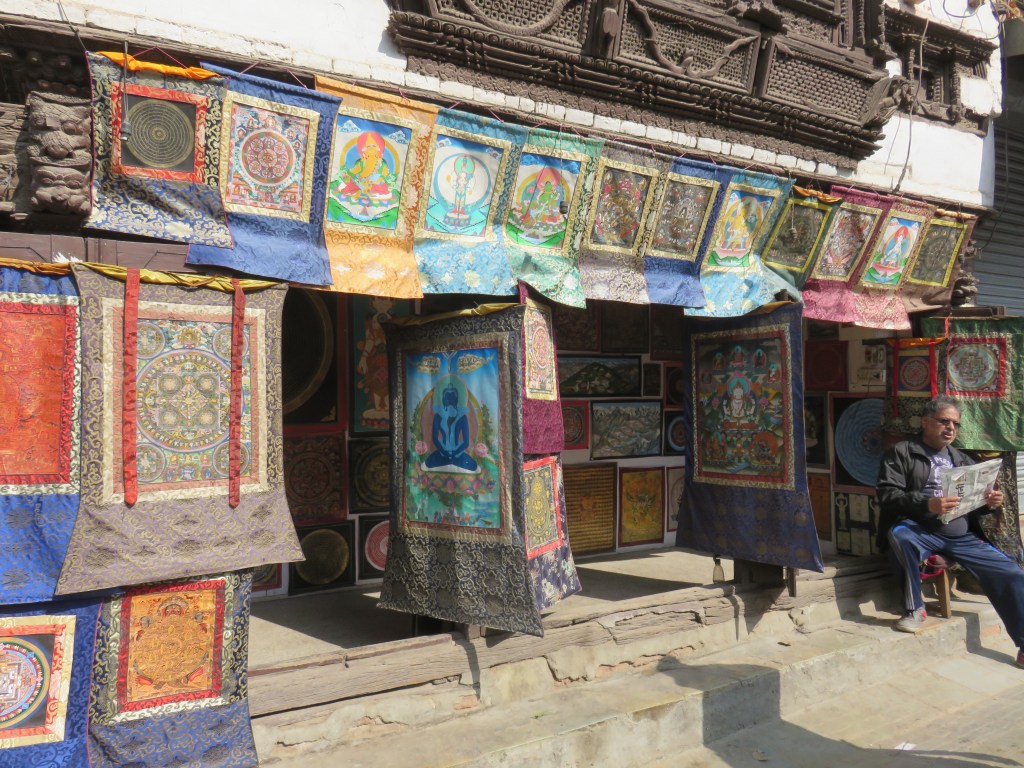
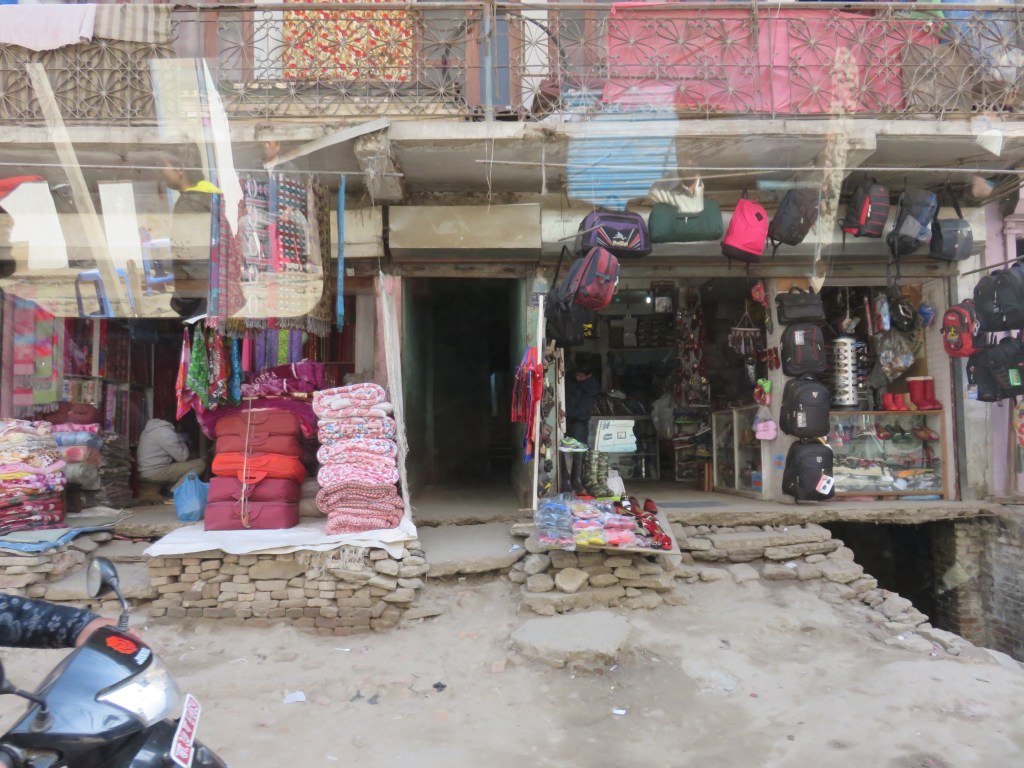
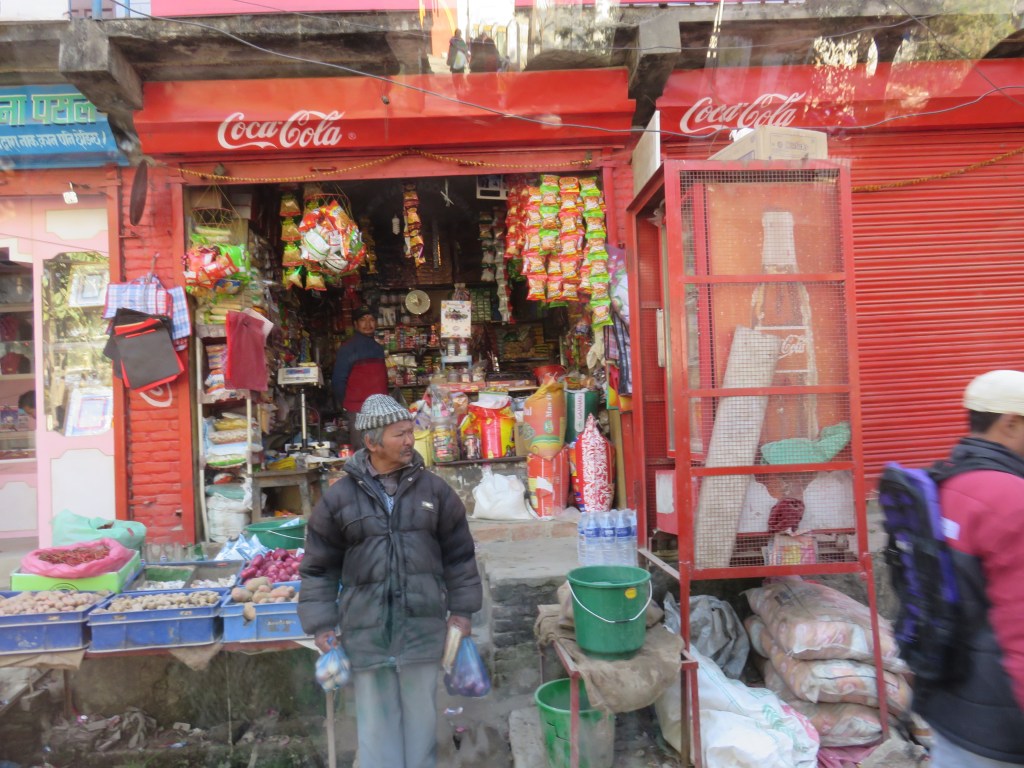
The streets are lined with buildings, mostly brick, often brightly colored, and in the market streets, little shops are cut like slivers into the buildings, their fronts completely open to the chaotic street. In one street you might see bolts of cloth stacked in the doorway and lining the walls, bursting with kaleidoscopic color; next door stainless steel ladles and pots hang glittering in the sun. Another shop offers scales, hanging in a neat row; next door to this, a pile of chickens, heads lolling, stacked in a pyramid on a plain wooden table; and next door to this, half-mannequins dressed in jeans, and fleece jackets on hangers.
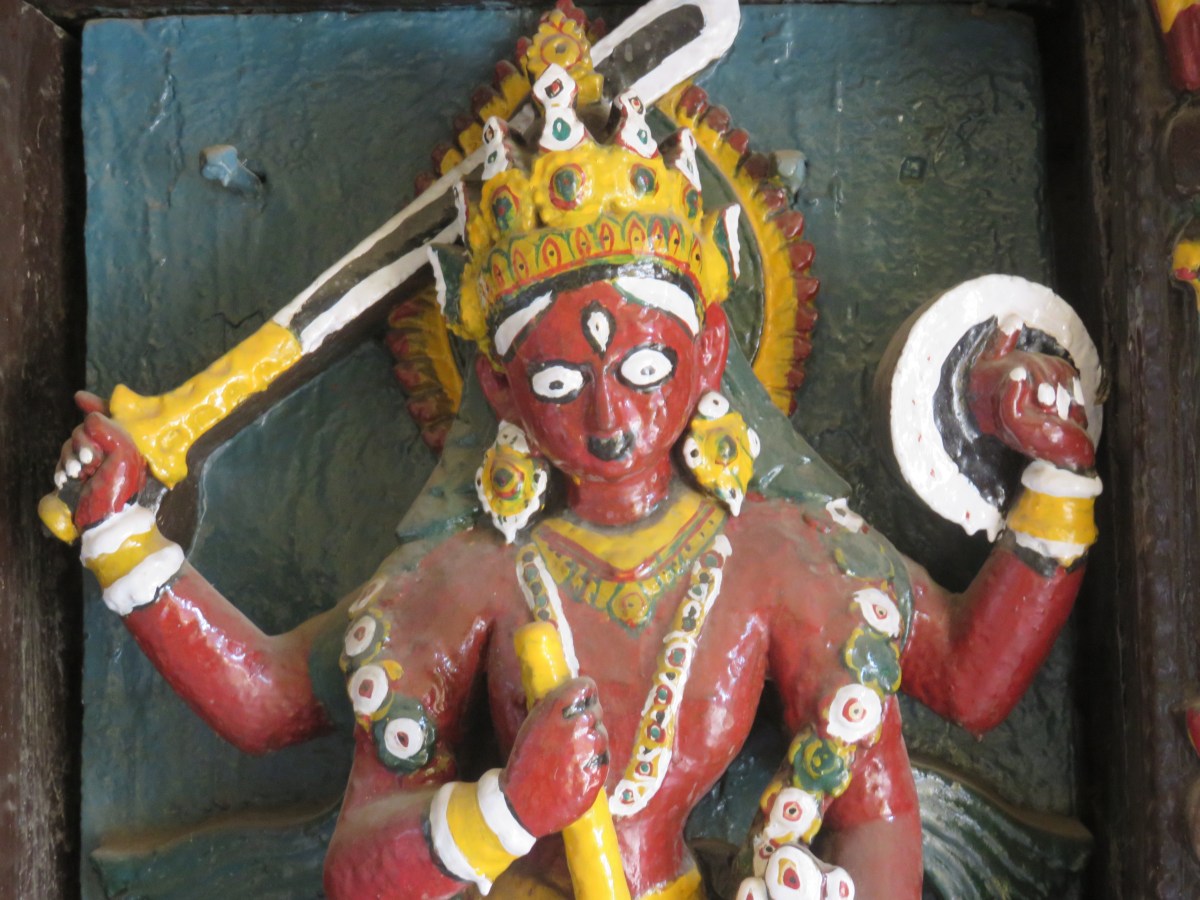
The taxi bumps and grinds its way along the street, dodging motorcycles, trying to avoid holes in the road and pedestrians, some in traditional clothes, walking obliviously with a load of goods towering high on their heads. Roadside shrines are everywhere…niches with statues of deities or small structures for deities to hide in; sometimes they are just small statues next to a building or right by the road.
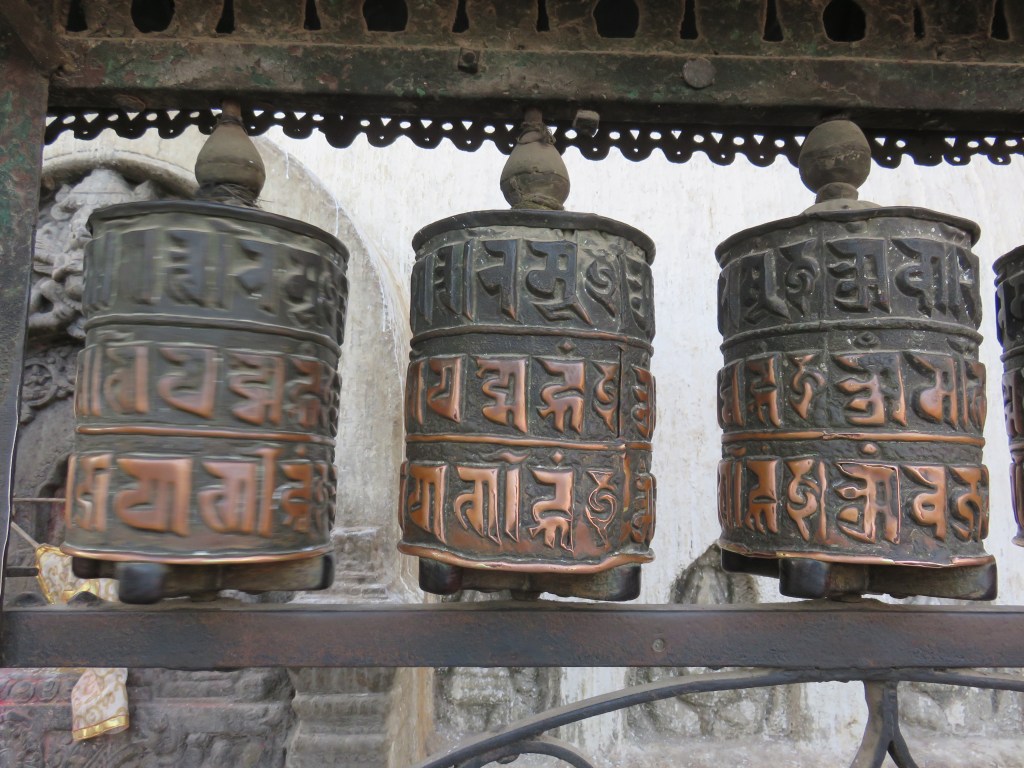
The next morning, some of us set out on a tour of Kathmandu, guided by a young engineering student. We began at the Budhanilkantha Temple, where the Hindu deity Lord Vishnu sleeps on a bed of serpents in a pool of water. It’s said that a farmer was plowing a field when he discovered this massive stone image of Vishnu buried in the soil. We received blessings from a holy man who marked our foreheads, and then we put our shoes on a rack and got in line to visit the Lord Vishnu. In front of Vishnu, people placed all types of offerings, but mostly rupees, and every so often, the attendant would scoop up armfuls of rupees and put them in an offering box
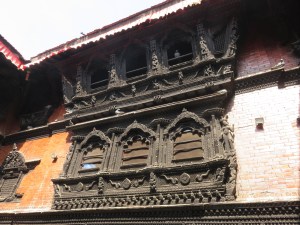
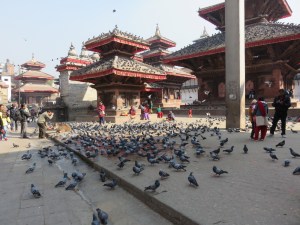
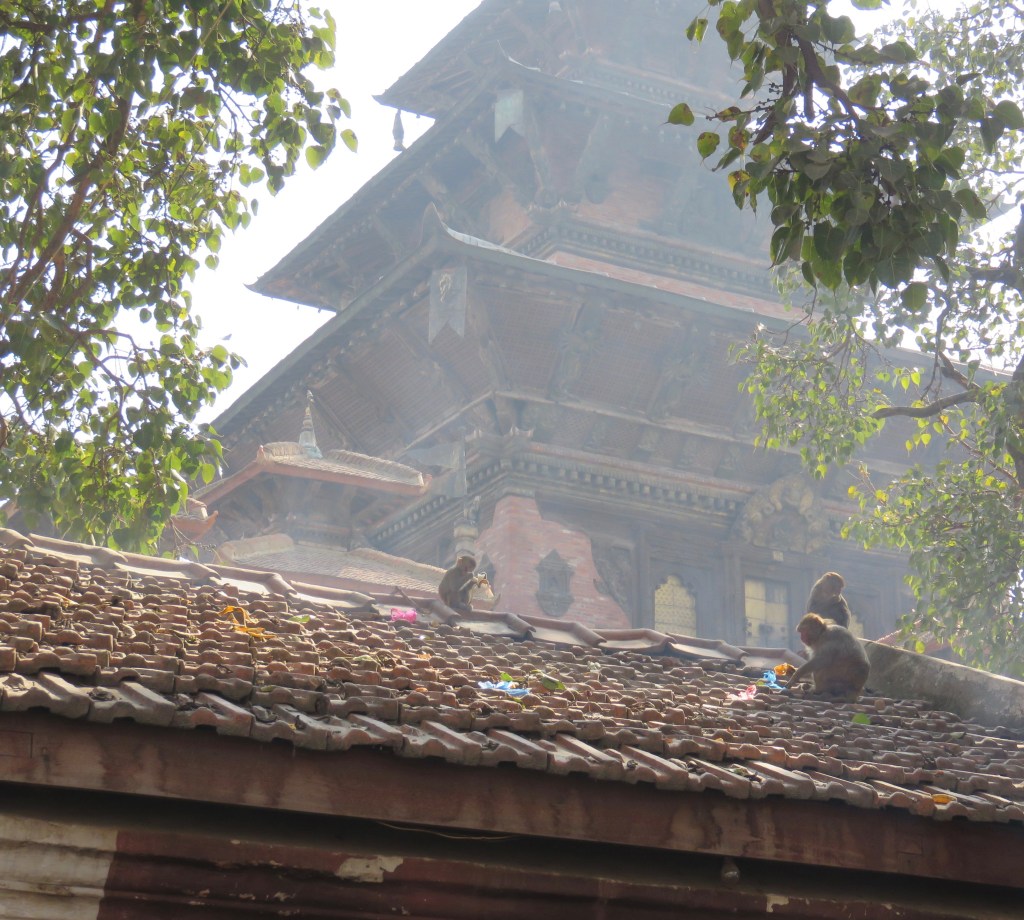
Our next stop was Durbar Square, the former palace of the Nepali royal family and an area of many temples, where we walked around. You could easily spend hours here visiting all the temples and shrines. The buildings are all hundreds of years old. One of the holiest is Kumari Ghar, where the living goddess Kumari lives. Every year a young girl, aged maybe 10 or 11, is selected to become Kumari, and she lives in this temple. She does not go to school, and only occasionally on holy days goes out to bestow blessings. When her time as Kumari is over, we were told, the girl goes back to normal life—how does one go back to “normal life” after a year of being revered and worshipped as a living goddess? We glimpsed her as she looked out over the interior courtyard.
Durbar Square
In the evening, we were to go to dinner at a restaurant called the Anatolia. In the hotel drive, we boarded a large coach bus and set out, but part way there, the bus stopped. We had to get off and board another smaller bus because our coach bus couldn’t fit through the narrow street. The smaller bus drove awhile then stopped and we walked the rest of the way. Luckily we didn’t have too far to walk in the dark—there are no streetlights, and the shops along the way were generally illuminated by one small light bulb.
Arriving at what looked to be a shop, we were led inside and up the stairs to the second floor restaurant. Inside, the large room had bright pink walls hung with paintings, and rows of tables, set up to accommodate our group. Along the street-side wall, other diners were trying to enjoy their meals as we all trooped in. Apparently the restaurant did not understand how many people were coming, because talk making its way around the room hinted that they did not have enough food for all of us! But no one was concerned and some of our group went shopping down on the street while we waited for our meal.
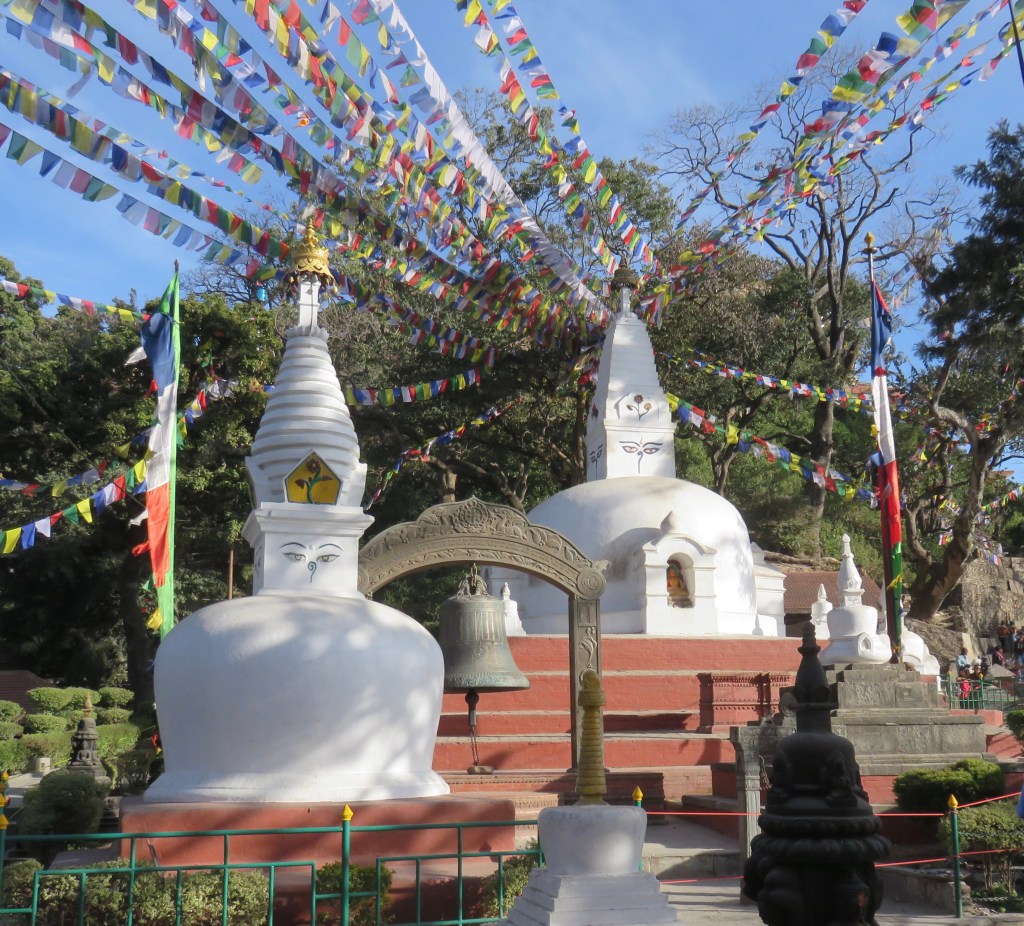
Our whirlwind tour of Kathmandu included visits to Bouddhanath Stupa and an aerial visit to Mount Everest before heading back to London and ordinary life.
In Massachusetts, the number of coronavirus cases as of this afternoon at 4 pm is 26,867, up from 20,974 on Friday—an increase of almost 6,000 cases just over the weekend. In the same time period, total deaths went from 599 on Friday, to 844 today. Governor Baker tells us that the peak is coming in the next ten days, but probably around April 20th. The numbers will get worse.
Following these developments over the weekend made me seek context. In some quarters, the fuss continues that this is just another kind of flu, and for awhile, I was harboring similar thoughts. So I went looking for some facts. It turns out that the CDC does not track actual flu cases. When you look into this, you find only estimates—no hard data. (I’m not a researcher, so the numbers may be out there; please share if you find them).
But stats for deaths generally are available. On any given day in New York City—normally—about 145 people, plus or minus a few, will die of various causes—heart attack, cancer, accident, violence. On the day I was looking at this, I found that 518 New York City people had died of Covid-19 alone! And a friend quickly pointed out after I posted this on Facebook that the one-day Covid-19 death toll had soon after hit 779.
This is not the flu. These are not usual flu season numbers.
It has now been almost 2 weeks since we went to the grocery store, and as perishables and essentials dwindle, we’ve begun to think about our next excursion. We also think we’ll cover our faces.
To that end, I dug out my collection of bandannas. (I’ve been holding onto these things for fifty years, waiting for them to come in handy.) I indulged in a little nostalgia as I laid them out and folded them, inhaling their dusty homeliness. My mom and I collected them for family camping trips; she used to pull one around her head for the morning trek to the ladies’ room, lest anyone see her unkempt hair. (I also remembered her wearing them while she was in chemotherapy, but that wasn’t a thought I wanted to dwell on just then.)
Will I wear one of my old, mint-condition bandannas to the grocery store this week? Next month? Or will we all turn to grocery delivery services? And give up the pleasure of perusing the potatoes and zucchini in real time? Will we forego that special kind of family quality time—the shopping trip? Or will we have to provide certification of virus-freedom at the entrance to the mall?
Or, for me, worse yet—I’ve only just begun going to rock concerts, reveling in standing shoulder-to-shoulder with 500 strangers while screaming my lungs out. (My May line-up of Asking Alexandria, Five Finger Death Punch & I Prevail are all postponed until September, along with the Within Temptation & Evanescence show we were supposed to attend at London’s O2 last week.) Will we have to present shot records to get in?
CNN showed the Chinese approach to the new Covid-19 normal this weekend—an app that tracks a person’s movements and gives you a QR code indicating whether you’ve stood next to anyone with Covid-19. You show the code to be admitted to an event. So just like we hold out our phones displaying our tickets to concerts, you would show your code to be admitted. Would anyone dare get in line with anything other than a green-for-go code? A recent Supreme Court case came to mind, the 2018 Carpenter cell phone case, where the Court decided that the use of cell-site location information records was a Fourth Amendment search, requiring a warrant and probable cause. Making an app like the Chinese Covid-19 tracking app unlikely here, at least for now.
I was supposed to be in London today, attending a concert by Brazilian metal band Semblant. Since I’m not there and can’t do that, here’s more from the beginning of the journey…
After Groningen, I could not wait for more—music, live music, live metal music! And soon after we got home from Groningen, Within Temptation announced that its Resist Tour was coming to the U.S. When I saw they were coming to Philadelphia, New York and Boston, over the first three days of March, that settled it.
The weekend got off to a great start. On Thursday, I am cruising through Connecticut along I-95, about halfway into the five-hour drive, mentally ticking off my packing list—now where did I put the tickets? Oh sh*t! Kristin had even texted to remind me to bring them, and I’d replied, sure, no problem, they’re right here on the fridge. And then I went off without them—needless to say, I’m in a panic. I get off the highway—naturally, no easy rest area or side street was handy, but I find a spot to get out of the way of traffic, and send Kristin a frantic message. Within a few minutes, my very tech-savvy daughter has it all under control: “Electronic tickets—everything’s fine.”
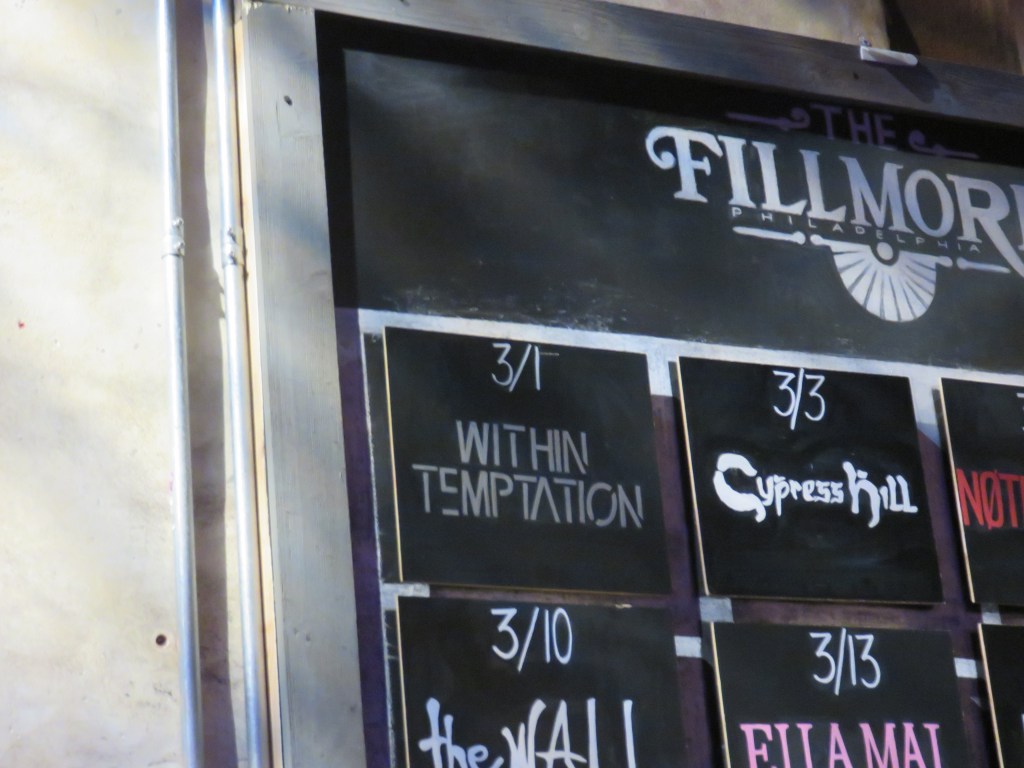
On Friday, we leave Kristin’s place crazy early for the hour drive to Philadelphia, running through Wendy’s first for what we believe will be our last meal for a long time, and then head to the Fillmore. The GPS leads us to what looks like a vacant lot with chain-link fence and barbed wire curled around the top, under an elevated highway—this is the parking? Luckily our friend from the Facebook fan group, whom we’ve never met in person before, arrives about the same time with a carload of more friends, and she knows the drill.
For all three shows, we have general admission tickets. We are packed onto the floor like sardines, with several hundred others. Groningen was the first time I ever experienced this. When we first get inside the venue, the crowd is thin—the die-hard fans arrive early, and the rest fill in later. All kinds of people are here, all ages, from little kids riding their parents’ shoulders to oldsters like me, most wearing band Tee-shirts, many sporting fantastical tattoos, long hair, short hair, all different color hair, from gray (dyed, on twenty-somethings—why is this trendy, I can’t help wondering) to cerise to blue (like mine). Some tiny college girls behind me are long-time fans of Within Temptation and seeing them for the first time—I will give them room, just as some of the In Flames fans moved over to give me room. One of my takeaways from the weekend was just how nice everyone is; you feel like you are crammed in with 500 of your best friends—literally.
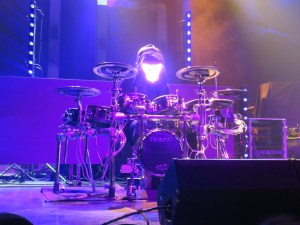
Smash into Pieces opens the show. First out is the drummer, completely hidden under a black cape and an illuminated mask, then joined by the others. The crowd slowly warms up—it seems this band is new to everyone else as well as me. But they lead off urging everyone to jump, and before I know it we are jumping and head-banging and every molecule in the room is vibrating. In the middle of it all, their vocalist dives into the crowd. Gasps and cheers—all I can see is his feet sticking oddly above the crowd, then vanishing. They’ve dropped him! But he clambers back onto the stage and with a wisecrack, goes on.
Next up, In Flames—the vocalist’s cheeky banter with the folks over there in the middle front, the white-haired, bearded guy with the gorgeous white guitar, the bass guitarist with his slashed jeans revealing a tattooed knee, the other guitarist with wild head-banging rocker hair and incredible biceps, and the drummer going crazy up there in back—I am grabbed by the throat and pulled into the music. If this is metal, give me more!
When Within Temptation comes out, they are as spectacular as I remember them, and this time, I sing along on many more songs. And when it’s over, all I can say is, “Wow, we get to do it again tomorrow!”
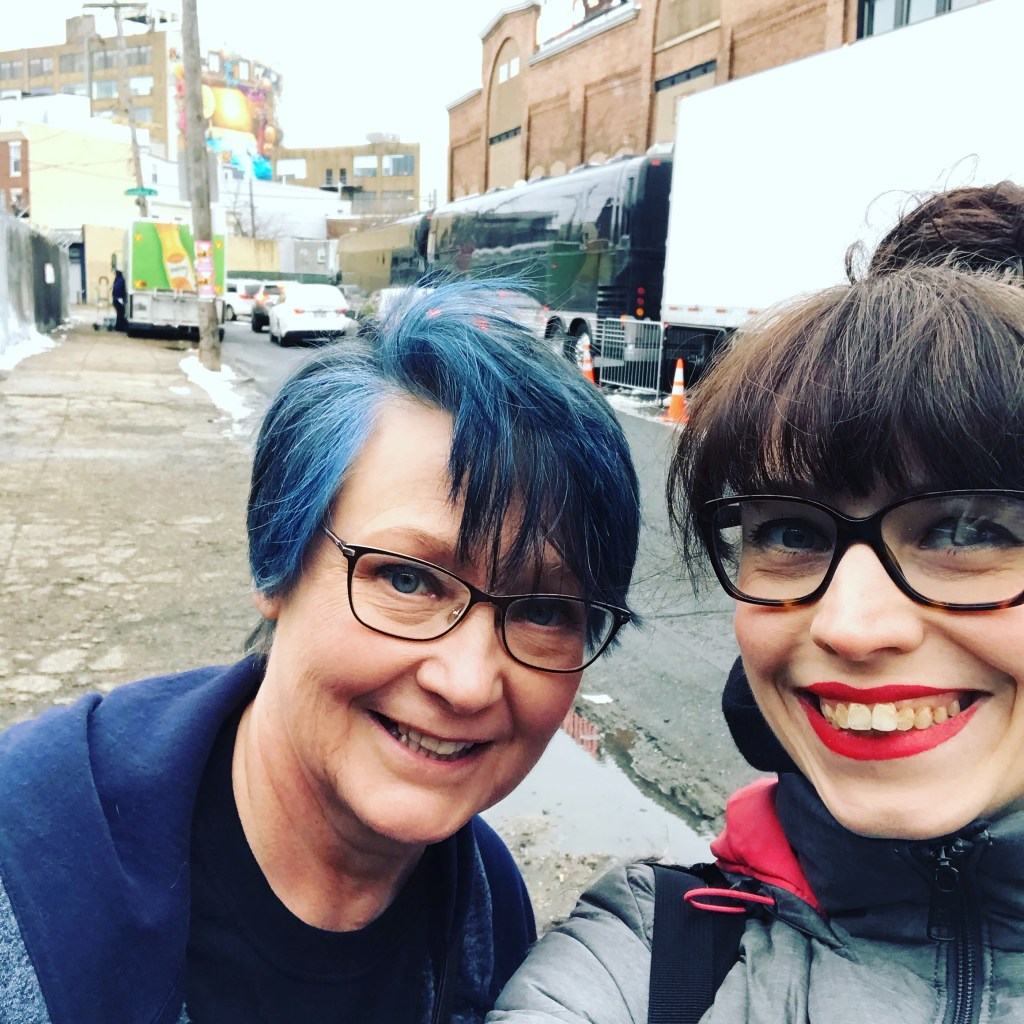
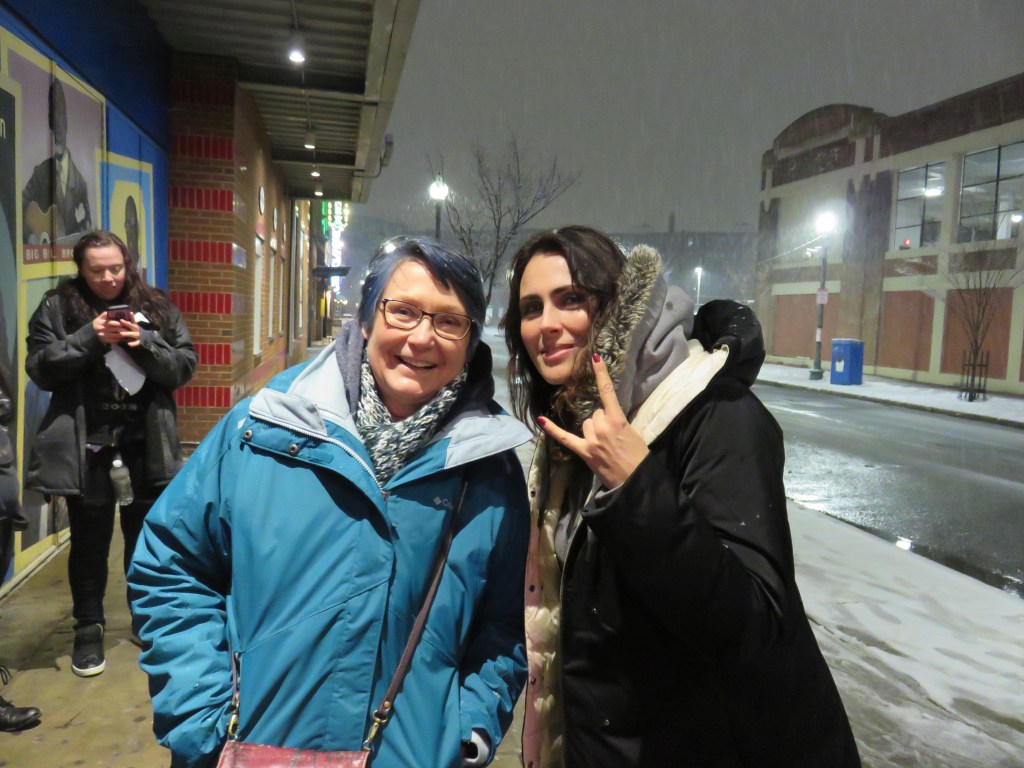
After the show, a clutch of us huddle together in the cold rain by the stage door, hoping Sharon and the boys will come and talk to us; she’d had some trouble with her voice initially and said she had a bit of a cold. But she does come over, and the others ask for photos. She agrees, but says, smiling, “Go home—it’s raining! Aren’t you cold?”
Finally we make our way to my car for the drive back to Kristin’s. The rain is turning to snow, and within a few more miles, it’s snowing heavily. We will flirt with this storm the whole weekend.
In the morning, we’re up and back in the car for the drive to New York, where we will catch the show at Playstation Theater in Times Square. We make another friend in the line at the theater. I satisfy a craving for a hot dog off a foodcart near the line. Then with our friend’s help, we secure spots at the barrier again. Some friends from Philly are here too.
Each band pulls me into their world—the musicians deep in their music yet feeding off the crowd, the crowd feeding off them, heads banging, singing along, horns up. Red and blue light fingers explode through the haze, the floor vibrates under my feet. I never want it to end!
Between bands, the lights come up and we chat with people standing near us. In New York, In Flames had a lot fans and one guy had been a fan for over ten years, and this was his first time seeing them live. His excitement at being there was over-flowing, and caught In Flames’s vocalist, Anders Friden’s attention. Anders asked him for his phone and tried to snap a photo of the crowd but the phone locked him out. The fan was devastated. But after the set, the setlist was tossed toward us, and I caught it and gave it to him, setting off tears of joy.
With the crowd warmed up by Smash into Pieces, In Flames further incites moshing and crowd-surfing. We keep an eye out, lest crowd-surfers slide in our direction. One guy surfs 4 or 5 times, with his lime green underpants hanging out.
After the show, we get our picture with Smash into Pieces. The drummer is still draped in black, right down to the black makeup on his (her?) hands. Kristin and our group of friends headed outside, but I lag behind for some reason, and as a result, get to chat with Anders and guitarist Chris Broderick who are hanging out by the door. “You converted me!” I tell them and fist-bump with Anders.
After dinner at the nearby Hard Rock Café, we catch the 7 train to a Marriott in Queens for the night. And then up and out to hit the road again, this time toward home—to Massachusetts.
Sunday was perfect driving weather, with plenty of sun and not a snowflake in sight, but by the time we arrive, the weather is degenerating. Our new friend from New York joins us in line at the House of Blues, directly across the street from Fenway Park.
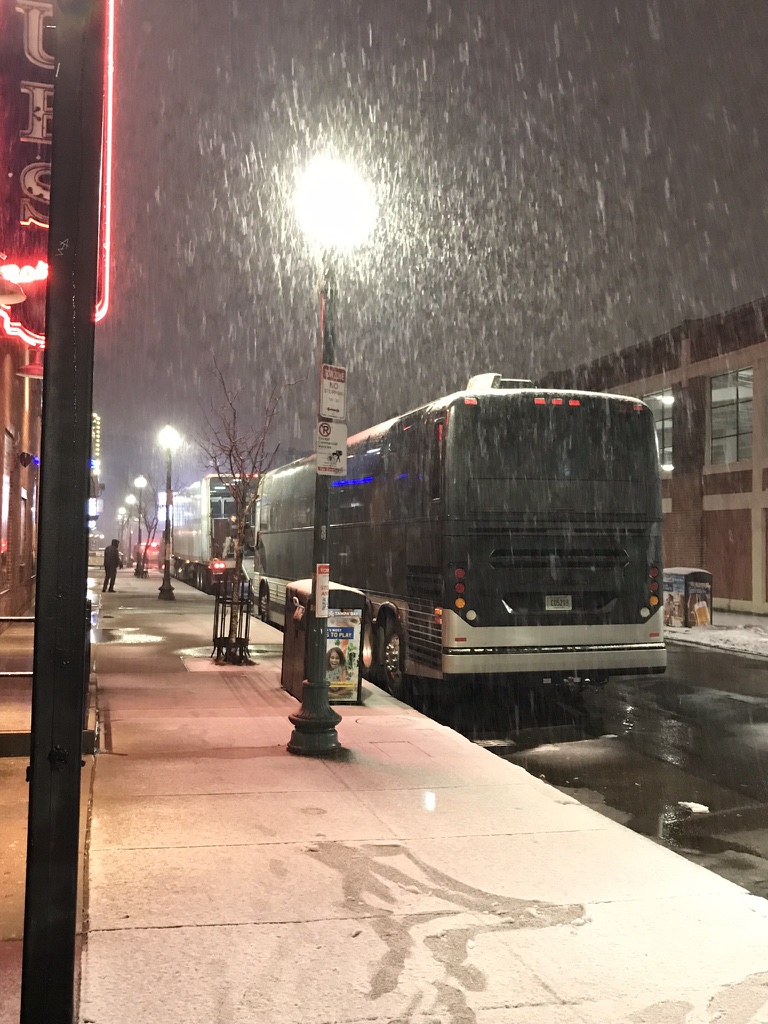
The show is a reprise of the two prior nights. Each crowd is different, but the atmosphere is thick with enthusiasm and excitement. Afterward, we emerge from the theater to find snow falling steadily and the street blanketed. WT’s bus is standing nearby. We pace up and down, stomp our feet, and watch the snow fall. We hope the band will appear. A couple at a time, they come out of the bus and wander over to us to chat a moment, sign autographs and take pictures, before heading to the pub down the block. Finally, Sharon comes out, and she too pauses to visit with us. They have a driving day ahead of them tomorrow, and she seems relaxed.
Tonight, with heavy snow forecast (already a few inches on the ground), my worried husband has lined up a hotel in Copley Square where we can sleep through the storm.
What a night, what a weekend. When’s the next one?
Today, we made our first foray to the grocery store after two weeks of self-isolation. In the last two weeks, we have gone out together once for a walk in the woods near our house, and once I drove to the beach a few miles away to go running. Otherwise, the only people we’ve seen have been the talking heads on TV.
After perhaps too much TV, I awoke this morning on edge about the excursion. It was exciting to think about just getting out of the house (such a change—I used to long a for a day to just stay home), but today, I also worried about what the store would be like, and what might happen to us because we went.
Our store is a typical, American grocery-extravaganza, always clogged with shoppers—families, twenty-something college kids from the nearby university, couples, moms with babies and kids in tow, elders on scooters. We planned our trip for mid-day on a Wednesday, since normally, on a Wednesday afternoon the store is deserted.
Today, when we arrived at the shopping plaza, the parking lot was empty, except for a mob of cars huddled at the grocery store’s end of the lot. It was definitely busier than a normal Wednesday.
Inside, where you grab a cart, a girl in an apron and gloves was wiping down the carts, and she passed one to us. The little dining area where you can usually sit down for a snack from the grab-and-go was blocked, the chairs upside down on the tables. Just beyond the registers, the path to the produce—or the bakery, depending how you look at it—was as congested as ever, with people hovering around the rotisserie chickens and turkey legs, and at the counter, eyeing the cakes and donuts.
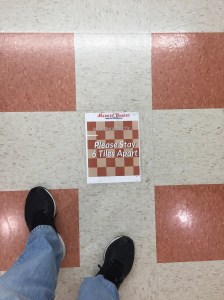
Signs on the floor remind us to keep our distance.
In the produce department, the crowd did not thin out as I’d expected. The aisles were busy. Some people wore masks, several wore scarves over their faces. Most were alert to the distance between us, and we nervously smiled as we tried to pass each other to get to the avocados. Signs plastered to the floor and across the meat aisle and deli counters helped us remember to keep the six-foot distance in mind.
We had a long list of items we’d been tracking over the last two weeks, for routine meals, particular recipes, or staples we always keep on hand. We were moving quickly through the store, giving wide berth to other shoppers. I am not usually phobic, and generally I enjoy grocery shopping, looking around, investigating new or interesting items. But today, midway through, a sense of foreboding began to rise in me. Just being here so long felt somehow dangerous. I need to get out of here! Our cart was full. It would cost a fortune. It’s time to go. Now.
Finally, we moved to the checkout counter. Here, unlike most days, we did not have to wait. We moved right into a checkout lane, behind a woman with just a few items in her cart. The masked man behind us hung back, easily ten feet away. No rushing to grab a divider to separate orders (in fact, there were no dividers at all). We’ve gotten used to using our own reusable bags—I have a picturesque one from our trip to Germany last summer—but today, no, the bagger said, can’t use those now.
Back at the car, we reorganized the bags into our reusable bags and filled the back of my Forester. In the car, we slathered on the hand sanitizer and drove home.
We need to order a few things online. For some reason, yeast and flour are hot commodities—has everyone begun baking their own bread? And we’ll do without a few things for awhile. And the bill was a shocker, but the pantry is fuller than it’s ever been. And we’re confident we can remain hunkered down for several weeks before we need to do this again.













 Linnea Arold Michel