


2015 was a pivotal year for me.
I grew up at a time when travel was limited to a privileged few, including briefly my grandfather, whose few business trips to Paris suggested the existence of a wider world. After I married, my husband’s active duty Air Force career bounced us back and forth between the East and West coasts. “Oh, you must travel a lot,” non-military people often commented, but, alas, we were firmly stuck stateside.
I felt like I’d never get to go anywhere.
Over the years, my husband became increasingly involved in his professional society, IEEE, the world’s largest technical professional society, and quietly climbed his way up their volunteer ranks. In 2015, he took over as the volunteer President of the IEEE board of directors. One of the President’s key roles is to represent IEEE at various events around the world, and I was fortunate to be able to accompany Howard on his global travels that year.
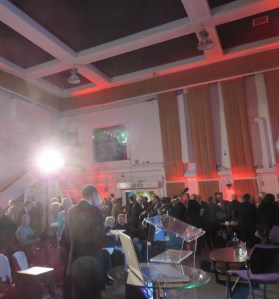
One such event that I shall never forget is the Milestone presentation at Abbey Road Studios.

Abbey Road is, of course, the iconic recording studio of the Beatles, and so many others—from Pink Floyd, the Zombies, and the Hollies to the London Philharmonic, and movie scores, like Lord of the Rings. Abbey Road is famous. But it is also historic, with a place in history that led directly to the creation of our present world of sound, music, TV, and movies.
The 1829 estate in St. John’s Wood, London, was purchased in 1928, and in March 1929, a young engineer named Alan Dower Blumlein, joined Columbia Gramophone, one of the predecessors of EMI. (Electric and Musical Industries, better known as EMI, resulted from a 1931 merger between Gramophone and Columbia Gramophone.)
Blumlein proved to be a prodigious inventor, filing 128 patents during his brief career. Blumlein filed his most famous patent in December 1931, when he was only 27 years old, “for improvement in and relating to sound-transmission, sound-recording and sound-reproducing systems” — what we know today as stereo.
In 1931, while at the cinema, Blumlein told his wife he could solve the problem of the unnatural sound of those early movies. Early movies and recordings were made with monaural (“mono”) sound. Because of its static nature, this type of sound is inherently unsatisfactory; flat and stationary, it lacks the dynamic quality essential to recreating a listener’s experience. Stereophonic sound solves this problem. Blumlein went on to make the first live stereo recording of the London Philharmonic Orchestra at Abbey Road Studios in 1934.
Blumlein was not only an inventor on par with Edison and Bell. A true war hero, his work with radar inestimably aided the Allied effort during World War II. Blumlein was killed at the age of 38, when the bomber in which he was testing a new radar system crashed on a hill in Ross on Wye, England, on June 7, 1942.
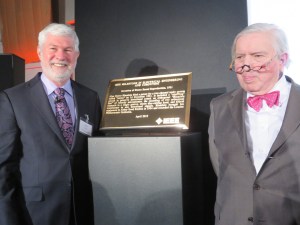
On April 1, 2015, my husband in his capacity as IEEE President, had the honor to present Abbey Road Studios with an IEEE Milestone, an award honoring “significant achievements in the history of electrical and electronics engineering”.
The Milestone was presented in renowned Studio 2 to Isabel Garvey, Abbey Road Studio’s Managing Director, and Simon Blumlein, son of Alan Dower Blumlein, thanked IEEE for its recognition of his father’s achievement.
For me personally, this event was a milestone along my own long and winding road, leading me back to the Beatles, and beyond.

Steinway 720 Provenance D Concert Grand Piano played by Paul McCartney, Elton John, and others 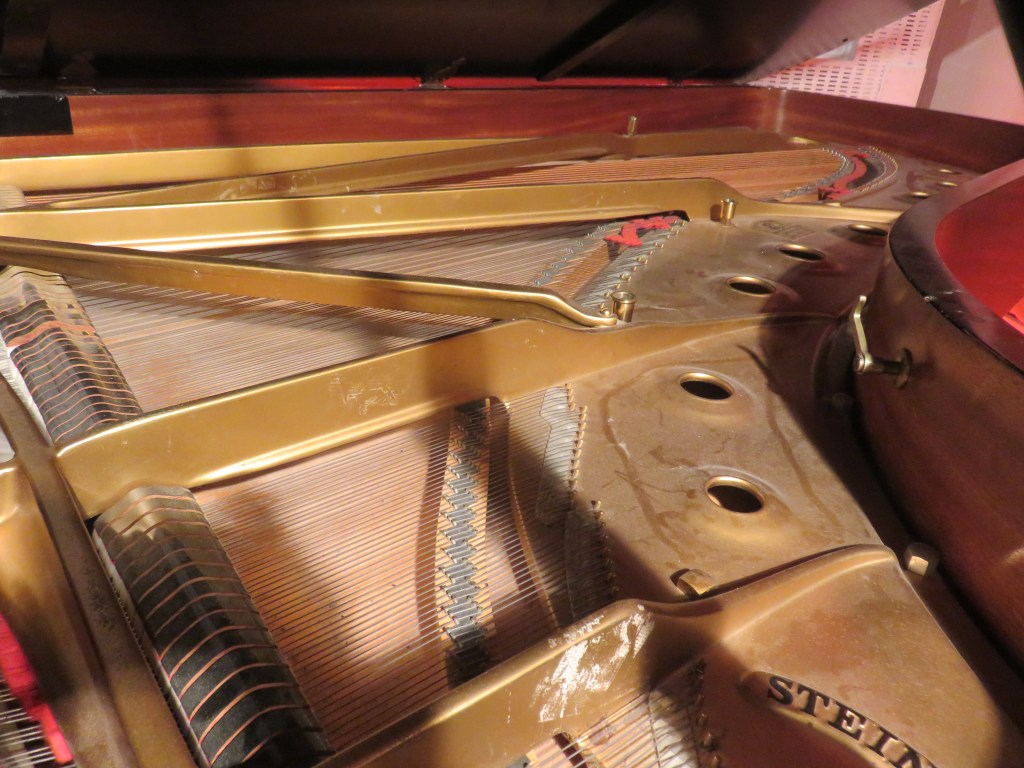
Another view of the Steinway Concert Grand 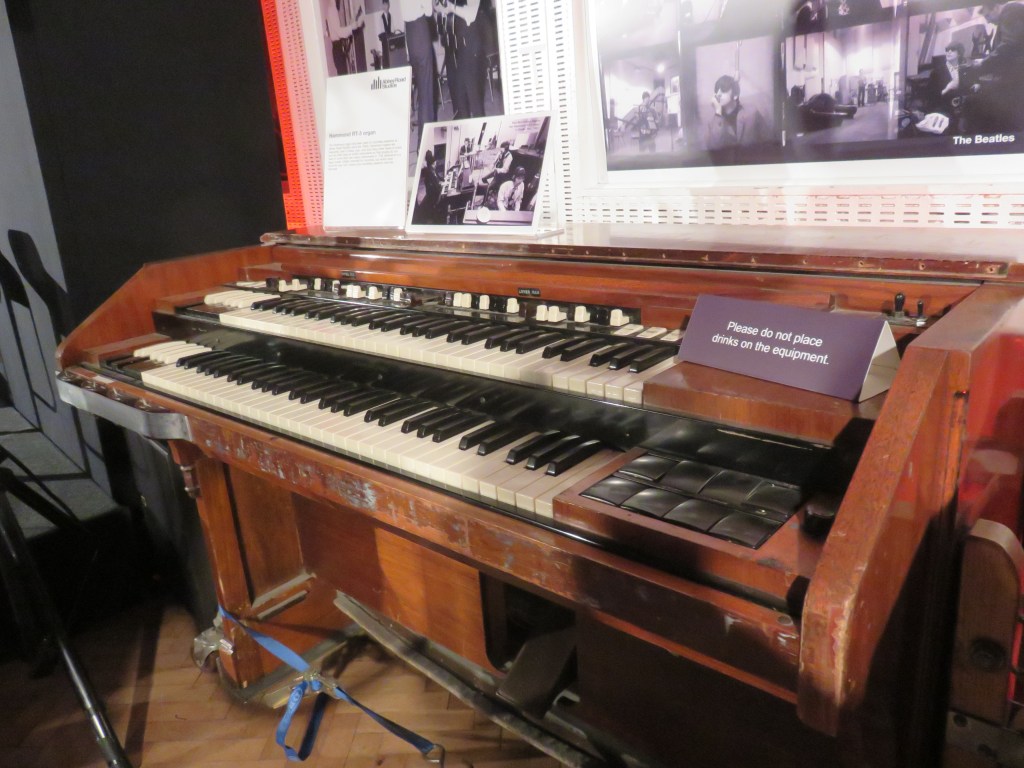
Hammond RT-3 Organ used by the Beatles in Studio 2 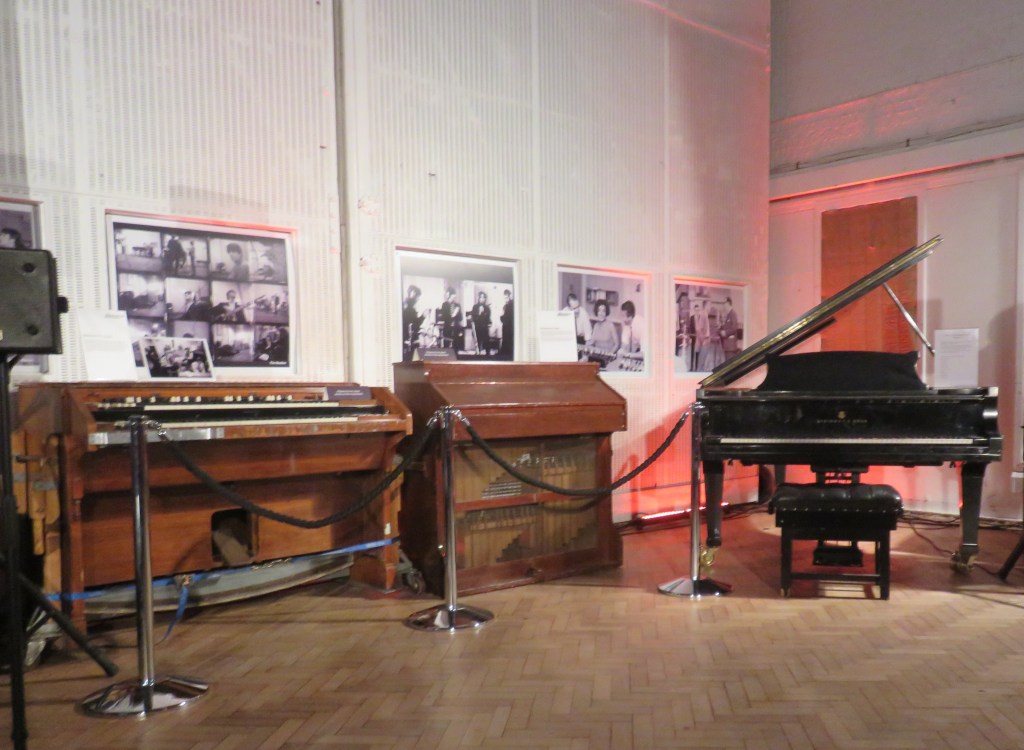
Instruments on display in Studio 2 
Schiedmayer Celeste, used for the intro to “Time” on Pink Floyd’s Dark Side of the Moon 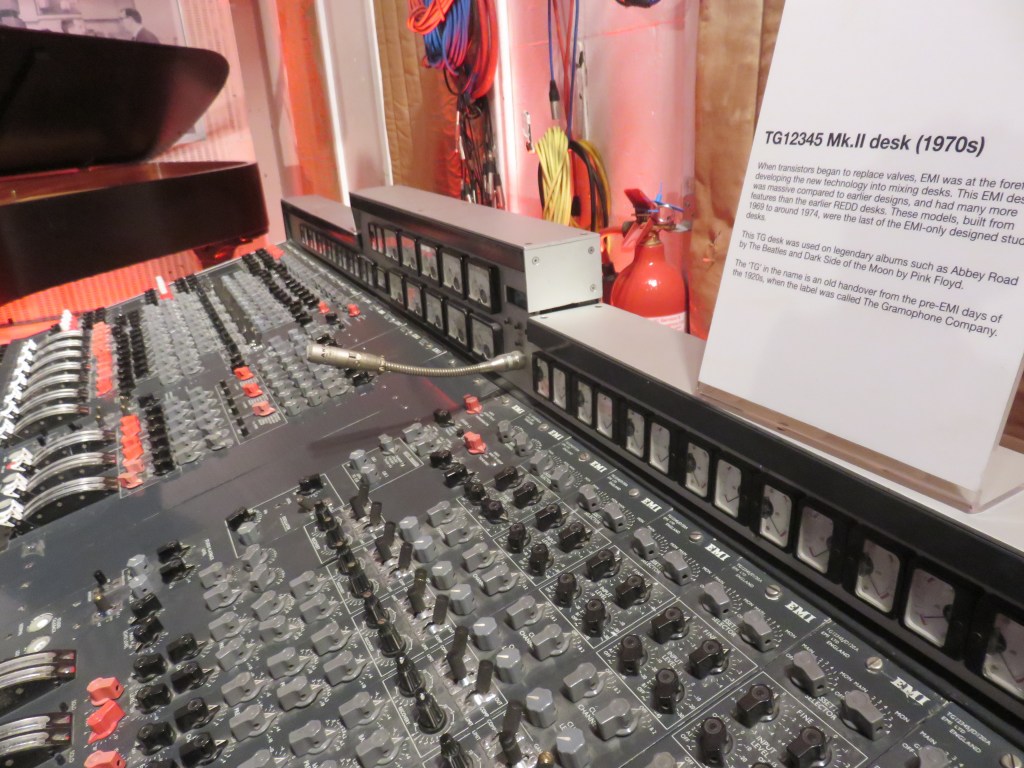
TG12345 Mk.II Mixing Desk (1970s) used by the Beatles for album Abbey Road and by Pink Floyd on Dark Side of the Moon 
Another view of the mixing desk
 Linnea Arold Michel