The media has been much concerned of late with the idea of re-opening the economy, as states begin to dial back their stay-at-home orders and lockdowns. We were told these would “flatten the curve” and protect the healthcare system from a fatal crash. We have hunkered down to slow the spread of the virus. The deaths—of friends, acquaintances, loved ones, the bodies bagged and stacked in makeshift morgues—have terrified us, motivated us to stay in, stay home.
Now (though we are surely not out of the woods yet), we begin to contemplate a new normal, where restaurants are half full, crowded bars are a distant memory, flight attendants wear masks, and we take a number to enter grocery stores. BBC News just ran a story about travel in this new world, complete with an airport disinfectant scenario straight out of Doctor Who.
As we hunkered down, bans on large gatherings were among the first social distancing strategies put in place. Now it’s been suggested that such gatherings may not be allowed this year. Suppose, for the sake of argument, the bans on gatherings of 10, or 100, people remain in place for a year, two years, or longer. As we shrink our worlds to avoid the risk of infection, what becomes of concerts, performances, readings and so many other events, and the artists and artist communities that these support?
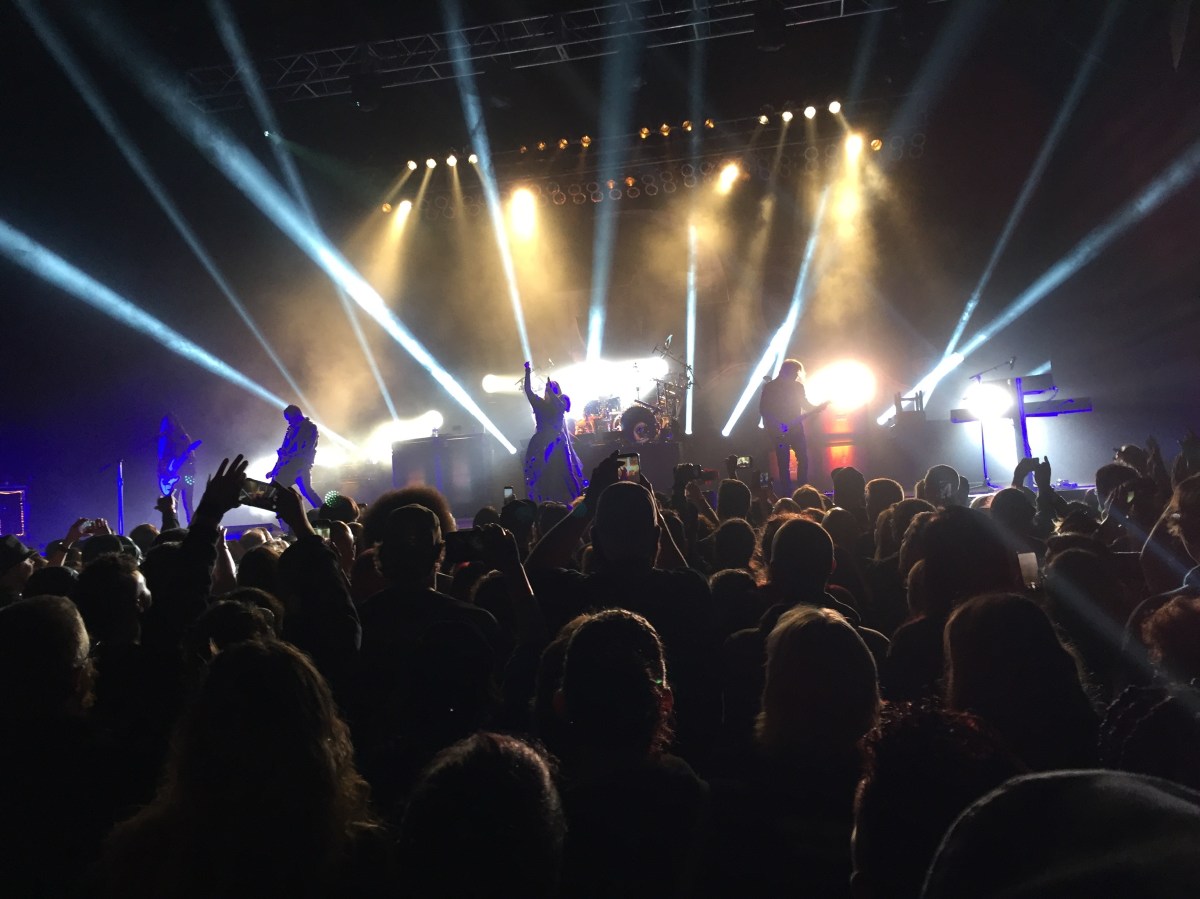
There was a time when this would have mattered less to me. I wasn’t going out to events much. But that trek to Groningen, Netherlands, to my first live rock concert ever, drastically changed my perspective. We were welcomed into a community—the metal community—where we stood shoulder to shoulder, hands raised, utterly carefree and full of life, singing the songs together as though we were singing hymns in church. What becomes of this community if we can no longer gather?
Large gatherings like this, whether 20 people for a poetry reading or 20,000 for a heavy metal concert, are intrinsic to every arts community.
If we have learned nothing else from our national experiment with Zoom meetings, it is that in-person is just better, whether it’s a meeting with colleagues, a trip to the ballgame or a concert. Relegated to the camera’s view, we lose a powerful world of nuance and non-verbal cues, of closeness and camaraderie. But perhaps especially for art, it is that personal, real-time experience shared with others of like mind that cements our relationships and unites us into community.
While community brings people together, it also serves a another purpose. Communities sustain the artists around which they form, and the music community is no different. Indeed, artists and their art-making have generated vibrant communities around the world, helping to reinvigorate cities everywhere and making arts a vital economic engine that can help ensure the continuation of independent artists making art for the joy of making art.
If we lose large gatherings, we risk losing the arts. The sustenance these large gatherings provide to artists—emotional, professional, financial—can vanish if performance venues can’t survive the new normal.
Without a question, even in a strong economy, arts are a tough way to make a living. A lot of parents, despite buying all those music and dance lessons, have pushed kids away from careers in the arts, telling their budding photographers and dancers, “You won’t be able to support yourself.”
This economic reality is a fact of the music world, where touring is a way of life for bands, who depend on tours to generate income. For heavy metal, historically, this has been especially true, since metal has tended not to get the radio play enjoyed by other musical genres (a topic of its own, outside the scope of this post). Few bands have the stamina and sustained creativity, to reach that elite world of musical nirvana where significant money is to be made. Before the pandemic had even started to unhinge our world view, Kobra Paige, of Kobra and the Lotus, talked about the economic realities she and her band face.
For our part as fans, we stand to lose a kind of sustenance too. We will lose the exhilarating experience of live concerts. I went so long without them, but now, reawakened, I crave them. I think about the concerts I’ve been to in the last year, that excitement, that feeling of being a part of this big, crazy family. We fed on the bands’ energy, just as the bands fed off ours to keep them going, night after night.
Vaccines and antibody tests already in development, contact-tracing tools like apps, and other public health strategies, if they work, might permit a return to large gatherings. Vaccines are undergoing trials in several countries. Apps are in development that will allow discovery of every person who stood within 2 feet of you; China has a version, UK is about to unveil one. In the US, approaches like these will encounter significant roadblocks due, for example, to our willingness to tolerate distrust in science, or to our laser focus on individual rights to privacy at the expense of the public good. From another perspective, the fear is that these strategies would “coerce” people into trying to catch the disease.
If we want to return to even a semblance of normalcy, we need to weigh our responses to public health tools and strategies with our common good in mind. We need to think about the impact of our personal decisions on others and on the communities we care about. We can no longer think solely of ourselves and our individual happiness. We must understand, now more than ever, that our happiness and well-being are tied directly to the happiness and well-being of others.
What do you think? Do large gatherings matter?
 Linnea Arold Michel